Developments in regard to the revision of Japan’s Corporate Governance Code

Japan is reforming its corporate governance code: following a small round table discussion, senior Japanese government and regulatory executives with supplementary material published by the Japan Shareholder Service. Below is a summary of what is in store for 2026 as to the next steps of reform of corporate governance in Japan.
Political backdrop and market context
In October 2025, Sanae Takaichi achieved a significant milestone in becoming Japan’s first female prime minister. After demonstrating strong leadership in the general election of early 2026, she formed her second cabinet in February 2026. While these political events initially contributed to a sharp rally in the equity markets, the positive sentiment was later overshadowed by increased uncertainty due to ongoing geopolitical tensions, especially those concerning Iran as well as a related rise in oil prices.
However, concurrently, Japan’s corporate governance reforms have progressed at a steady pace. Key discussions have been taking place over the last six months: a new iteration of Japan’s Corporate Guidance Code is underway.
Progress on corporate governance code revision
The Corporate Governance Code, originally established in 2015, is undergoing its third major iteration, set for completion in mid-2026. The revision process has entered a new stage, with an Expert Panel on the Revision of the Corporate Governance Code now presiding over discussions. This Panel comprises Jen Sisson, CEO of ICGN; Kaoru Kobu, Head of ESG at Invesco Asset Management; George Iguchi, Chief Corporate Governance Officer at Nissay Asset Management, as well as corporate representatives, business and labour organizations, and legal professionals.
Key themes under consideration
− Streamlining the Code by focusing a “principal based” approach rather than “rule-based”, and moving detailed provisions into interpretive guidance.
− Placing greater emphasis on the allocation of business resources including capital, with boards now expected to provide stronger justifications for cash holdings and clearly explain how resources are directed towards supporting growth and shareholder value.
− Introducing earlier disclosure of Annual Securities/ Integrated Reports, ideally ensuring they are published at least three weeks prior to Annual General Meetings (AGMs).
− Enhancing the functions of the board secretariat to provide improved support and facilitate better information flow within boards.
− Strengthening the effectiveness of outside directors, with a focus on their qualifications, independence, and appropriate numbers.
Additional detail
− A new Preamble will clarify that the Code is principles-based and operates on a ‘comply or explain’ basis in order to achieve the objectives of the Code.
− Dialogue with shareholders will be given greater prominence and addressed at the beginning of the Code.
− The responsibilities of boards will be both clarified and strengthened, especially in relation to risk management, including areas such as cybersecurity, supply chain integrity, and data leakage.
− The Code will elevate sustainability and diversity, integrating these responsibilities into higher-level principles.
− Rules governing cross-shareholdings will be tightened, with several provisions upgraded to core principles.
− Clearer expectations will be established for the timely disclosure of Annual Securities Reports ahead of AGMs, supporting more informed investor decision making.
Overall, these revisions are intended to streamline the Corporate Governance Code, strengthen governance practices, and promote more transparent, strategic, and accountable boards.
Streamlining the Corporate Governance Code
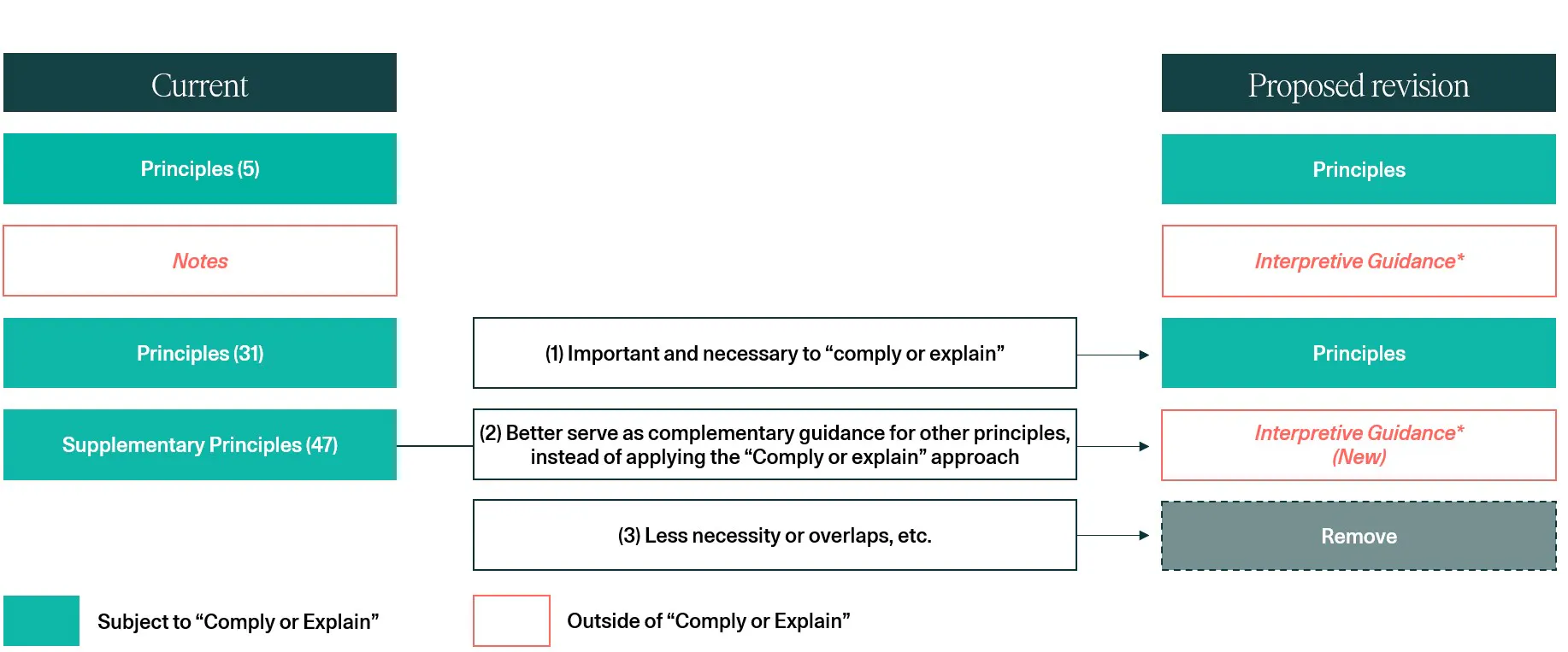
Source: Financial Services Agency, “2nd Meeting of the Expert Panel on the Revision of the Corporate Governance Code”
Material 1: “Secretariat Briefing Pack”
Elevation and streamlining of principles
Supplementary Principles that are considered highly important and well suited to the ‘comply or explain’ discipline will be elevated to Principles. This change ensures that critical guidance is embedded within the main framework of the Code, strengthening its application and clarity.
Provisions that are more effective as support for other Principles, will be reformulated as new “Interpretive Guidance” in order to promote deeper, more substantive implementation. This approach is intended to provide boards with clearer context and practical assistance in applying the main Principles of the Code.
Additionally, provisions that have become less necessary - either due to established market practice or their overlap with rules introduced after the initial publication of the Corporate Governance Code - will be removed. This streamlining helps maintain the relevance and efficiency of the Code.
Allocation of business resources
Regarding the allocation of business resources, including cash reserves, the draft revision clearly states (in Principle 4‑1) that boards are required to “explain” specific measures that will be taken in order to achieve growth related to allocation of business resources such as growth investment, review of their business portfolio and shareholder return. The accompanying Interpretive Guidance (for Principle 4‑2) further underscores that boards “should persistently review the allocation of company business resources (…) including whether cash is utilised efficiently in investments.” This guidance supports enhanced transparency and encourages strategic management of resources.
Timely disclosure and shareholder rights
The Interpretive Guidance (for Principle 1‑2) recommends that Annual Securities Reports be submitted at least three weeks prior to general shareholder meetings to facilitate timely disclosure. Additionally, the guidance suggests that listed companies should consider adjusting the dates of general shareholder meetings and the record dates for exercising voting rights from current customary practices, and implement further measures to promote appropriate exercise of shareholder rights. These revisions aim to support informed decision-making and enhance participation among shareholders.
Strengthening board secretariats and outside directors
With respect to board secretariats, the Interpretive Guidance (for Principle 4‑13) underscores the importance of “promoting initiatives such as enhancing the functions of the board secretariat (e.g., corporate secretary) who supports the board.” In addition, other Principles further clarify expectations for the roles, responsibilities, qualifications, number, and independence of outside directors. These clarifications aim to improve the overall effectiveness of outside directors, ensuring that boards benefit from their expertise, independent judgement, and oversight.
Summary
The planned next revision of the corporate governance code not only moves from “rule-based” to principal-based”, but also streamlines the Code to make it more transparent and effective. There will also be more clear direction as to board accountability and responsibility. Overall, this iteration should elevate investors’ confidence in governance of Japanese corporates and shareholder value creation, hopefully resulting in further improvement in efficient capital allocation and market value creation through share price appreciation.
This material is provided for informational purposes only and does not constitute investment advice or a recommendation. The views expressed reflect current market conditions and are subject to change without notice.
All materials have been obtained from sources believed to be reliable, but their accuracy is not guaranteed. There is no representation or warranty as to the current accuracy of, nor liability for, decisions based on such information.
Investment strategies presented are not suitable for all investors and do not represent the experience of other clients. Results may vary and are subject to change based on market conditions and individual circumstances. Investors should consult their financial and tax advisors to assess the suitability and risks of any investment.
Portfolios may include investments in illiquid assets, securities subject to counterparty risk, and instruments sensitive to changes in exchange or interest rates. Derivatives such as futures, options, structured notes, and contracts for differences may be used for risk management or investment purposes but may also involve a higher level of risk and may not be suitable for all investors. There is a risk of loss and of counterparty default on such instruments.