Zen no more: Japan’s bond market breaks out

Just over two years ago, we wrote of how the re-emergence of Japanese inflation would mark a turning point towards higher government bond yields. In our bond funds, we took short Japanese Government Bond (JGB) positions to monetise the trend, benefitting as the 10-year yield rose over 1.5% since December 2023. Revisiting the theme, key questions remain: what is Japan’s macroeconomic outlook, is there further upside for JGB yields, and what implications might this have for global financial markets?
Background: Japan’s economic miracle, and the Lost Decades
The 1950s-1980s were economic heydays for Japan. As the country rebuilt following WWII, it implemented cutting edge technologies and optimised factory design to prioritise automation, efficiency and scale. Japan’s industrial sectors thrived and a managed exchange rate under the Bretton Woods system helped keep exports competitive, whilst urbanisation and a young and growing labour force meant that demographics helped boost both domestic supply and demand.
Economic success was reflected in asset prices; during the 1980s, Japan’s main stock index, the Nikkei 225 rose at an annualised pace of +19.5%, outperforming the US Dow Jones by 264 percentage points over the decade. In the last five years of the 1980s alone, the Nikkei 225 more than tripled, and by the end of the decade Japanese stocks accounted for nearly 50% of global stock market capitalisation. Real estate followed a similar pattern, with the Japanese property market valued at over four times that of the total US property market. The bubble was alive and kicking.
The Bank of Japan (BoJ) was forced to curb the excess via a sharp rise in policy rates and a coordinated tightening of bank lending conditions with the Ministry of Finance (MoF). The party ended dramatically in 1990 with the stock market falling 39% in that year, continuing declines through 1992.
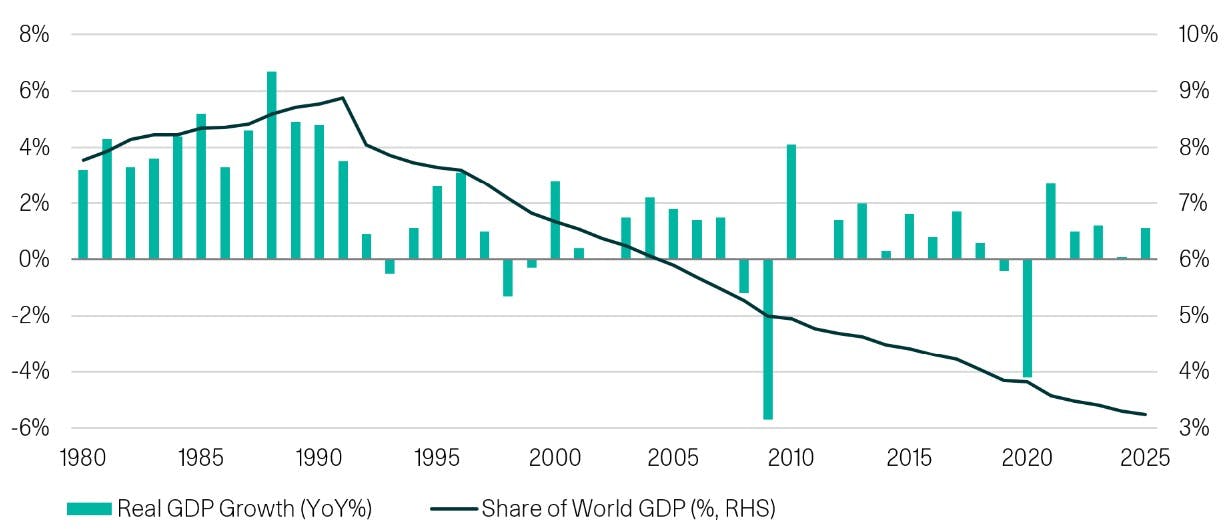
This collapse ushered in the Lost Decades. Corporations prioritised debt repayment over investment, while deflation encouraged delayed consumption. Productivity fell, wages stagnated, and economic growth slowed. Societal changes emerged: risk aversion increased, birth rates declined, and the population aged, leaving Japan grappling with long-term stagnation. The Nikkei 225 would not recover its lost ground until 2024.
Japan's falling share of World GDP
Source: IMF, W1M. Data as at 31/12/2025
Policy measures & bond market reaction
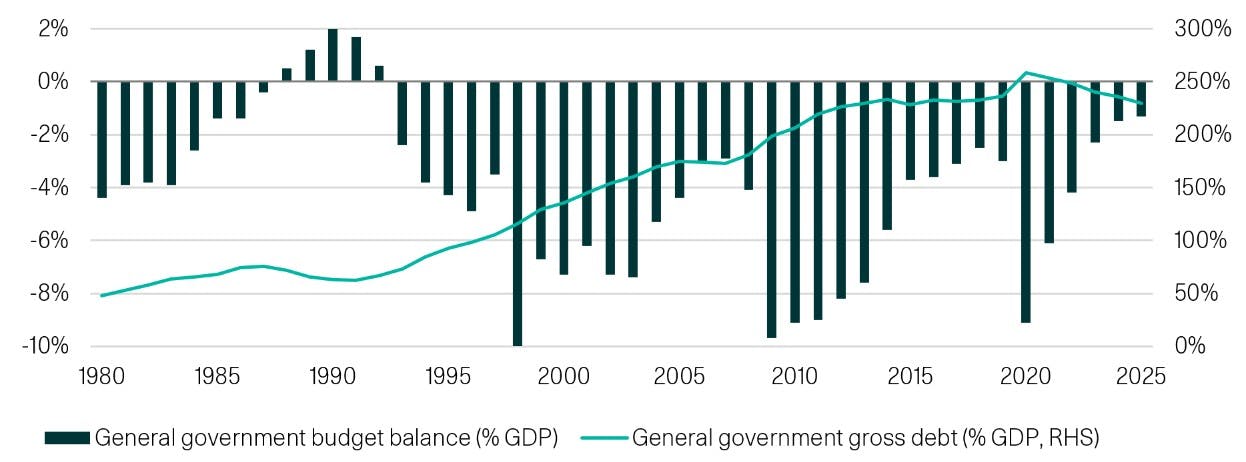
Fiscal policy became the primary countercyclical tool. Successive stimulus packages aimed to support growth and employment, but with limited success in reigniting consumption. As a result, government debt began a steady and ultimately dramatic ascent. By the late 1990s, Japan’s gross debt-to-GDP ratio had surpassed that of other major developed economies and would continue to surge higher to over 250% by 2020.
Japan budget balance and debt
Source: IMF, W1M. Data as at 31/12/2025
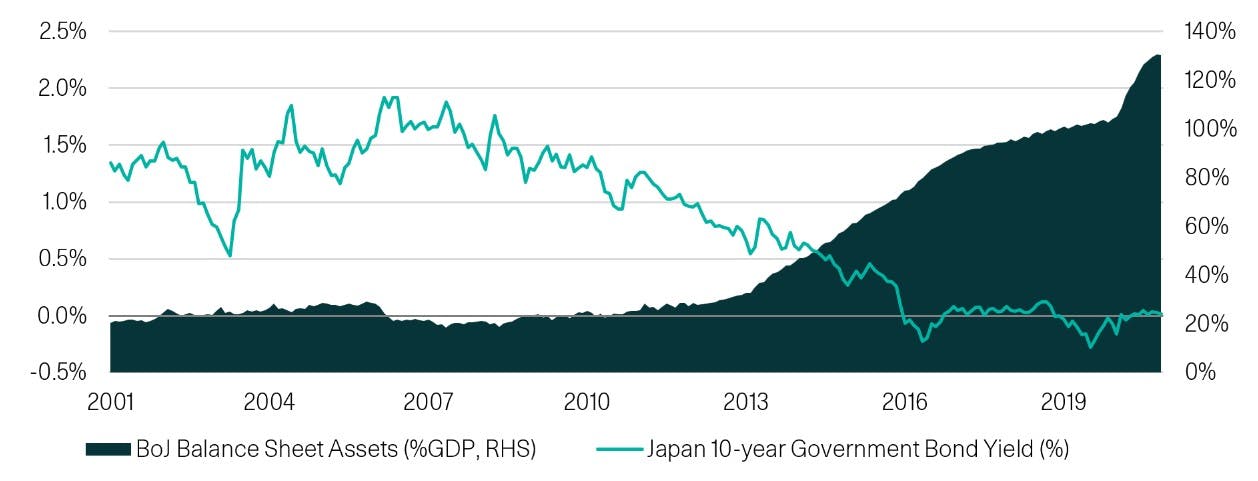
The BoJ was the first major central bank to introduce zero interest rate policy (ZIRP) in 1999 and implemented a large-scale quantitative easing programme in the early 2000s. In 2016 the BoJ went further, taking the policy rate into negative territory (NIRP) and introducing yield curve control (YCC) to suppress longer rates.
Unsurprisingly, this cocktail of persistent deflation, cautious investor behaviour and a huge price-insensitive buyer of government bonds in the market led to an uninspiring yield environment. As the BoJ’s balance sheet soared to over 130% of GDP, 10-year JGB yields compressed to zero, trading below this threshold on multiple occasions.
BoJ balance sheet and 10-year JGB yields through 2020
Source: Bloomberg, W1M. Data as at 31/12/2020
Economic shockwaves lead to political discontent
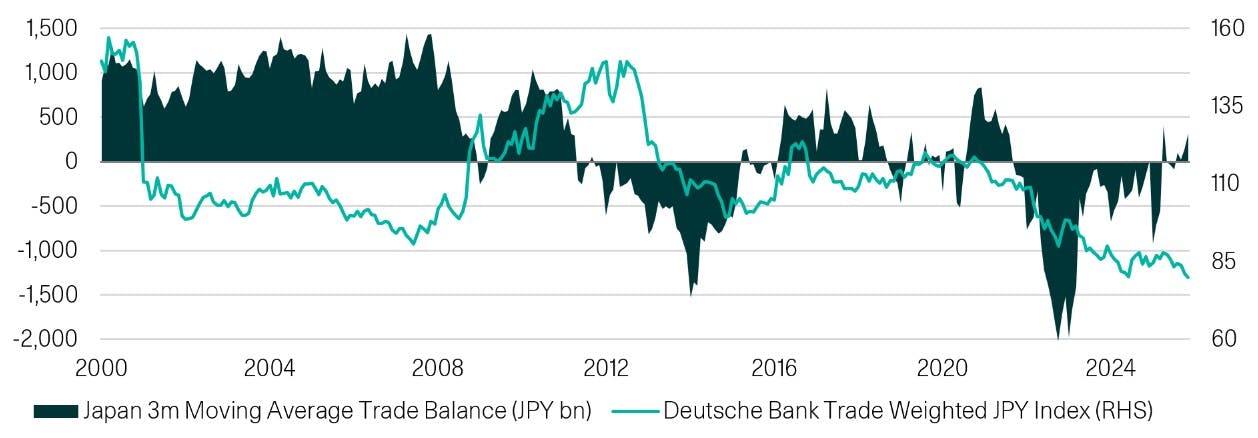
Enter the pandemic. As the global supply shock reignited inflation, the BoJ maintained NIRP, fearful of killing off fragile domestic growth with little concern for nascent price rises after years of structural deflation. Meanwhile global central banks hiked rates sharply, widening interest rate differentials and pressuring the yen. Japan, importing nearly 90% of its energy supply, saw soaring energy prices after Russia’s invasion of Ukraine, exacerbated by the weak currency, and the country’s trade balance deteriorated sharply. Cue further yen pressure which subsequently weakened by 30% against the dollar in the five years following COVID as capital flowed to higher yielding currencies.
Japan trade balance and JPY index
Source: Bloomberg, W1M. Data as at 30/11/2025
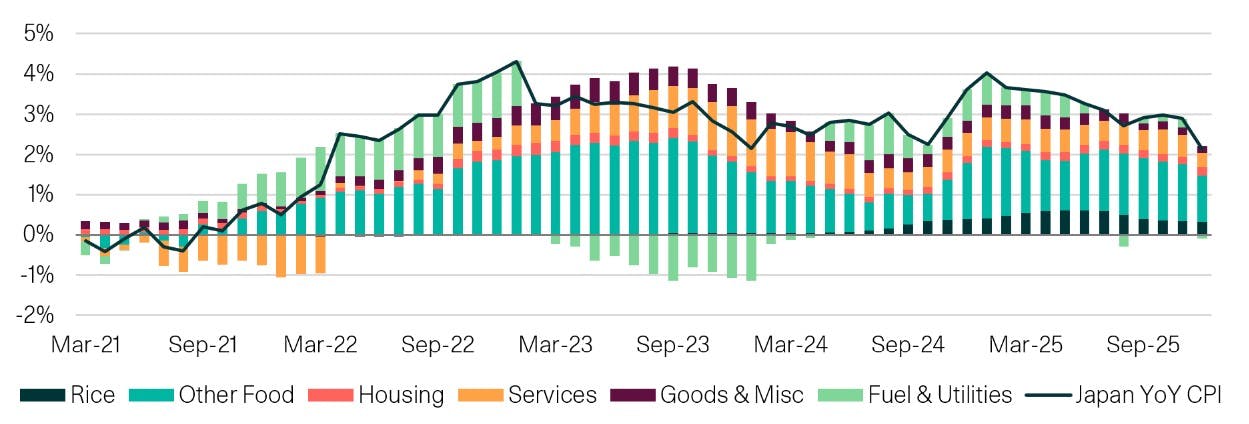
Japan’s appetite for rice has also contributed to domestic price pressures. Due to poor harvests, falling labour supply and the weak yen, rice inflation breached 100% YoY in 2025, and at 0.6% of the CPI basket has represented an average 15% of total inflation over the past 12 months.
Japan CPI components
Source: Bloomberg, W1M. Data as at 31/12/2025
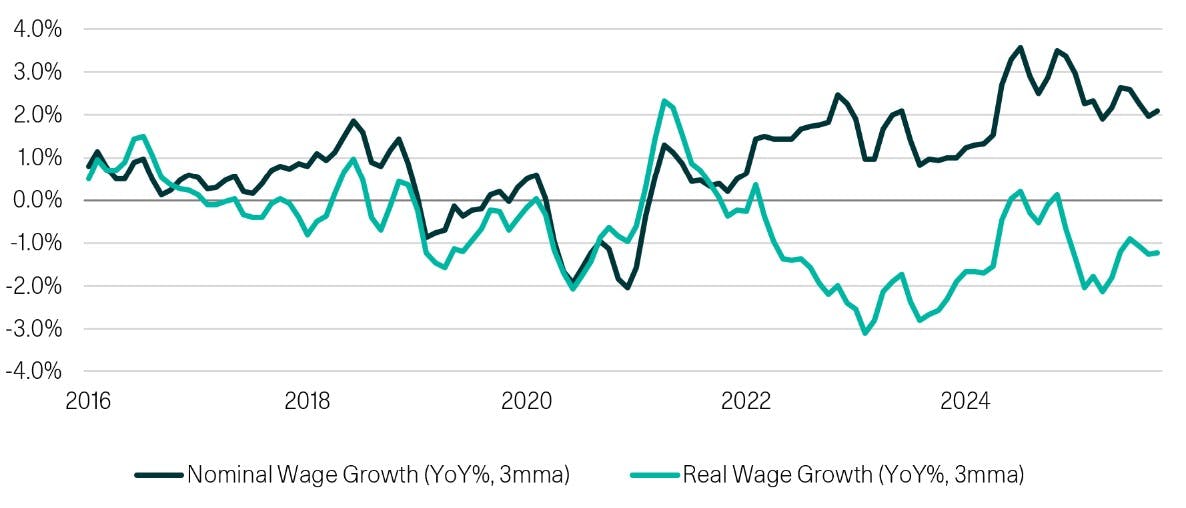
Consumers felt the pinch, and despite nominal wage growth showing some signs of life, real earnings growth has remained depressingly negative. It is no surprise therefore, that discontent with the ruling Liberal Democratic Party (LDP) came to a head in 2025 elections with the party losing its majority in both Diet houses for the first time. Following the resignation of PM Ishiba, Japan’s first female PM Takaichi has taken the reigns.
Japan wage growth
Source: Bloomberg, W1M. Data as at 30/11/2025
Takaichi has been clear that a loosening of the fiscal tap is coming. In November 2025 she announced a mammoth ¥21tn (USD 135bn) stimulus package including energy subsidies, rice coupons and child support payments. Earlier this year she unveiled her ¥5tn (USD 32bn) plan to suspend the 8% sales tax on food for two years and announced a general election on February 8 aiming to secure a party majority to push the spending measures through. In sum, the fiscal pressures could worsen Japan’s budget balance from around -1.4% to a deficit of over -3% GDP in 2026. JGB yields, which had been trending higher, accelerated their selloff in January, with the 40-year yield breaching the 4% level for the first time in its history. The debt-to-GDP ratio has been recently falling as nominal growth has outpaced the interest burden and deficit of the country. A huge fiscal package could reverse this trend, with elevated bond yields increasing the interest rate burden to a level higher than nominal GDP growth in the coming years.
Monetary policy
The BoJ finally ended its YCC framework and raised interest rates for the first time in 17 years in March 2024. Since then, the policy rate has been hiked to 0.75% yet still looks low compared to inflation. When analysing the real policy rate by realised inflation, it is clear that negative Japanese real rates remain a significant outlier. Adjusting for market-based inflation expectations tells a similar story.
Real central bank policy rates
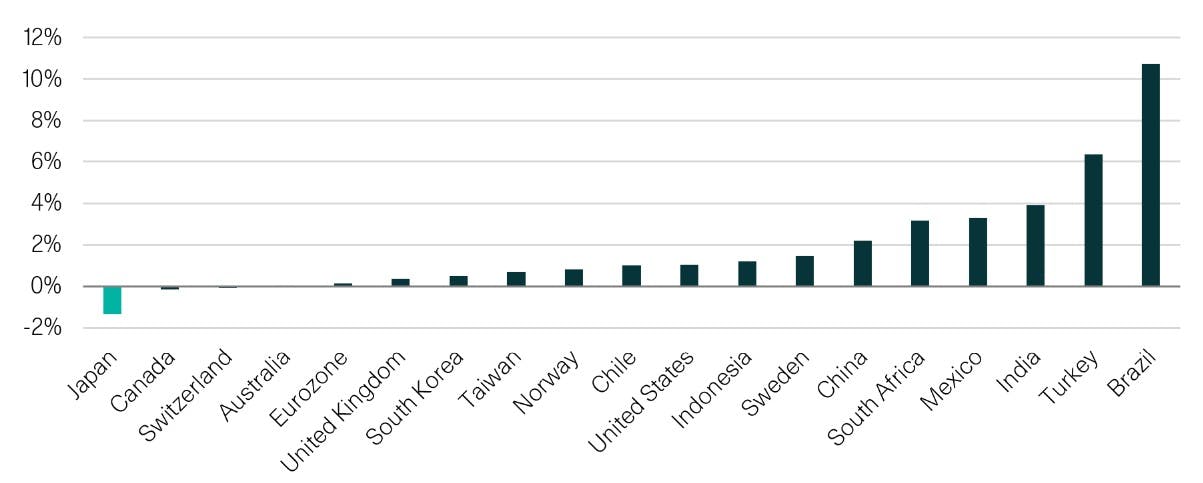
Source: Bloomberg, W1M. Policy rates adjusted for latest YoY CPI print. Data as at 31/12/2025
In its January 2026 Monetary Policy Meeting, the BoJ revised upwards its outlook for growth and inflation, in light of the government’s economic stimulus package. The BoJ stated that “it is likely that the mechanism in which wages and prices rise moderately in interaction with each other will be maintained, and that underlying CPI inflation will continue rising moderately”. The labour market is tight with near-full employment due to the shrinking working age-population. Wage growth pressure is likely to be robust as workers demand higher pay increases to combat the real wage destruction in recent years.
Currently, the swaps market prices just over two 25bps hikes to policy rate for the remainder of 2026. The forward curve suggests a terminal rate around 1.5-2.0% is likely. In this range, the real rate would still remain negative, suggesting further normalisation of the policy rate, and of market expectations, is required.
A Truss Moment?
The Gilt market’s reaction to Liz Truss’s unfunded tax cuts in Autumn 2022 offers a cautionary precedent as Takaichi signals large-scale fiscal spending in Japan, coinciding with a spike in JGB yields. This raises the question of whether Japan faces a similar moment of reckoning, and what the implications might be for global bond markets.
Several factors mitigate the impact of higher JGB yields domestically. JGBs are predominantly held in Japan, with the BoJ alone owning nearly half the stock. Despite tapering QE, the BoJ still purchases over ¥2tn (USD 13bn) per month. Higher yields and lower prices do not translate into immediate losses for the BoJ under amortised cost accounting, with significant realised losses only occurring if it undertakes large-scale active sales. Japan’s strong net international investment position and large domestic holder base reduce reliance on foreign buyers, and debt service costs remain modest at around 1.7% of GDP, compared with 3–4% in the US and UK.
At yields not seen for decades, JGBs are increasingly attractive to domestic investors, both standalone and versus US Treasuries after hedging costs. Repatriation of capital from Treasuries is possible, though limited so far due to JGB volatility and domestic balance sheet constraints. As BoJ policy normalises, hedging costs for Treasuries may fall, improving their relative appeal. Nevertheless, with over $1.2tn of US Treasuries held by Japanese investors, any significant shift could have material implications for global bond markets.
Conclusion
Core CPI inflation is unlikely to accelerate significantly, but elevated wage growth suggests further central bank policy normalisation, currently not reflected in market pricing. JGBs may face intermittent volatility as markets digest higher fiscal stimulus and bond supply, though such episodes should be contained and are unlikely to trigger a UK LDI-style crisis. Despite recent moves, we believe yields have further upside. Accordingly, we maintain short JGB positions in the Waverton Sterling Bond Fund and Global Strategic Bond Fund, alongside long JPY positions, expecting further rate normalisation to support the currency.
This material is provided for informational purposes only and does not constitute investment advice or a recommendation. The views expressed reflect current market conditions and are subject to change without notice.
All materials have been obtained from sources believed to be reliable, but their accuracy is not guaranteed. There is no representation or warranty as to the current accuracy of, nor liability for, decisions based on such information.
Investment strategies presented are not suitable for all investors and do not represent the experience of other clients. Results may vary and are subject to change based on market conditions and individual circumstances. Investors should consult their financial and tax advisors to assess the suitability and risks of any investment.
Portfolios may include investments in illiquid assets, securities subject to counterparty risk, and instruments sensitive to changes in exchange or interest rates. Derivatives such as futures, options, structured notes, and contracts for differences may be used for risk management or investment purposes but may also involve a higher level of risk and may not be suitable for all investors. There is a risk of loss and of counterparty default on such instruments.