Waverton European Funds Annual Update 2025

Market Insights
Last year was an exceptional year for the European stock market. In USD terms the Spanish market, the IBEX, was the top performing global market in 2025, (beating the S&P500 and Nasdaq).[1] That being said, under the broader arc of financial history, for over fifteen years Europe has dwindled in comparison to US dominance.[2]
Donald Trump is a divisive figure but one thing we can thank him for is the renewed investor interest in Europe. Trade wars (tariffs / China), hot wars (Ukraine) and US culture wars have driven many to reappraise how reliable America is as an ally and the result has been higher defence spending in Europe. This shift in geopolitics has coincided with favourable macro conditions on the continent, as a broad interest rate cycle has lifted both the financials heavy index and investor ebullience to new all-time highs.
Fund Performance
The Waverton European Capital Growth Fund was up 21% vs the index up 19% for the year in EUR. Our relative performance was especially pleasing this year given we are 11% underweight financials which were over half the index performance (12% of the 18%). Unlike in the US, financials still constitute 1/4 of the European index and have been a big driver of the region’s struggles at an index level post the Great Financial Crisis (GFC).
The Waverton European Dividend Growth Fund was up 30%, vs the index 26% in GBP. Whilst there is c. 75% overlap in the holdings of the two funds, this year the focus on income served the Dividend Growth Fund particularly well. There was particularly strong performance from our utilities. Iberdrola +43% and EDP +30% (in GBP) which have benefitted from renewed investment in grid capacity and electrification, whilst insatiable demand for Data Centres / AI has driven a sector rerating.
Investment Philosophy
As a reminder, we believe, that all things being equal, sustainable and profitable growth in cash-backed Earnings Per Share (EPS) is what drives share prices in the long term. The problem is that where this is obvious the market will price this growth to perfection, leaving little room for any margin of safety. We believe that in applying the capital cycle and rigorous competitive supply side analysis we can identify companies with structural growth in EPS ahead of them, before the market gives them credit for it.
In the Waverton Capital Growth Fund we have generated c. 7% EPS growth compound since inception of our funds vs. the index at 4% below. In the Waverton Dividend Growth Fund we have generated a similar total shareholder return made up from roughly half dividend (3.5%) and half earnings growth (3.5%).
Trailing EPS since December 2001
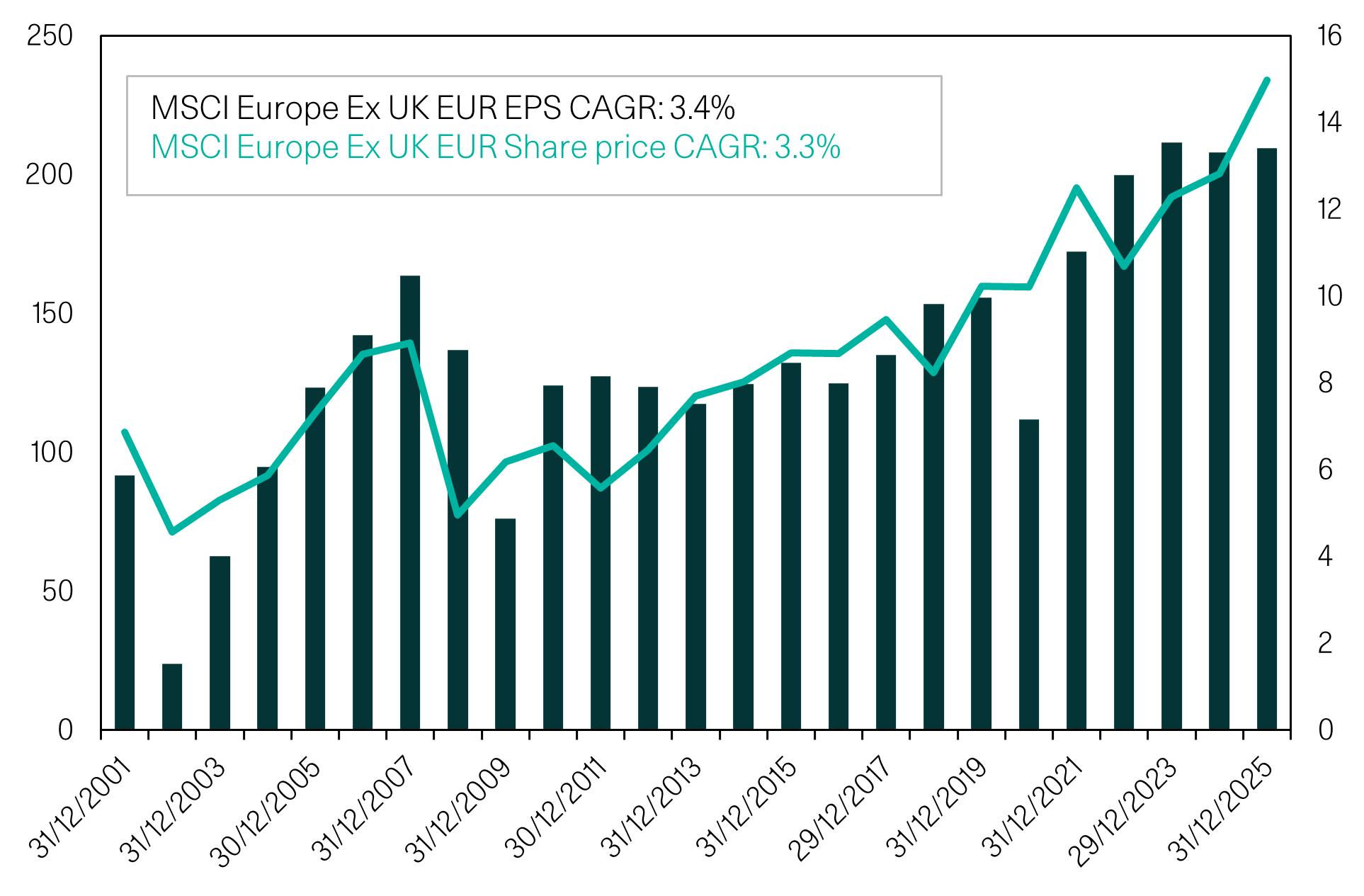
Source: W1M & Bloomberg
Risk management (measured as risk of permanent capital loss rather than volatility) leads us to try and avoid excessive valuations where possible and we would prefer to pay a “no growth” multiple for a business that has the potential to grow rather than nosebleed valuations for investments where all investors can see is blue sky.
That said, our portfolios consist of roughly half “margin improvers” and the other half “steady growers”. The ideal life cycle is that a lowly rated margin improver grows into a steady grower that we can recycle into further interesting opportunities. This is because a margin improver should benefit from both increased earnings and a rerating on the increased earnings whilst a steady grower tends to only benefit from the former. We do, however, recognise that there are companies (steady growers) that have very high moats to competing effectively, e.g. our exchanges, and so we will use market dislocations or “trips” in the companies’ operating performance to take a new position in a steady grower, which tend to be more stable than margin improvers given their higher starting margins and dominant market positions.
Year in review: Themes, Sectors and Stocks
Our top performers this year are dominated by the broad-brush industrial segment. Our defence stocks, Dutch insurers, and miners, all made the top 10 performing stocks and each have their own stories.
Defence Companies
When we first bought into our two defence companies; Kongsberg in 2015, and Indra in 2019, it would have been impossible to predict the boom in European defence expenditure we saw last year because of Trump. In 2025 Indra roughly tripled whilst Kongsberg was flat following a very strong run from 2021-2024.
Our original thesis was built on the view that these two companies were unusual in being forward facing in the equipment they are making whilst a lot of European defence is focused on 20th century technology like tanks/ships. When we bought them, they were trading at significant discounts to where their global peers were, despite very strong technology.
We paid 13x PE for Indra when we initiated our position in September 2019. This was for a company with an effective oligopoly in air traffic management (ATM) with 1/3 market share and that had been selected for the cutting-edge Future Air Combat System (FCAS) that aims to provide a European answer to the F-35. The company has now come through its governance issues of 2022 with a vote in June this year to rebalance the board to 50% independent directors. It has become the de facto Spanish defence national champion winning 40% of the value of Spanish contracts in land vehicles, space and systems. We think this warrants the 20x PE it now trades on given the weight of contracts that could still be won.
When we first bought Kongsberg it traded on c. 18x PE and now it trades closer to 30x. Like Indra, Kongsberg is strong in modern forms of warfare, especially ground based air defence, where it competes with Lockheed’s Patriot system. Kongsberg provide the only ground-air missile system with integration between NATO fleets and the F-35 ecosystem making them a partner of choice to many European nations beefing up their domestic defence systems. Only this year they have won contracts from Denmark (500m EUR) and a further upgrade from Norway with Belgium, Luxembourg, Netherlands and maybe Sweden on the horizon. Whilst the stock has re-rated we think this is more than justified given the backlog has swelled from 15bn NOK when we bought to 140bn NOK today. There is also likely value in the proposed spin out of their marine business.
Dutch Insurers
When the regulator pushed the Dutch pension industry from larger group defined benefit schemes to more individual contribution-based schemes only the largest providers had the technology to manage the change.
As result, the industry started consolidating. NN Group bought Delta Lloyd Life and ABN Amro Pensions, whilst ASR had acquired Aegon leaving the market in the hands of four main players. We used the consolidation as an opportunity to invest in the Dutch insurance business back in 2023.
When we first bought NN Group the business traded on 0.6x book value with a 7% dividend yield despite the fact they were (and still are) generating c. 2bn of capital every year which is c. 20% of their total required payments. Since our original investment, NN has returned 2.1bn EUR in buybacks and dividends which is over 20% of the market cap at the time of our original investment.[3] The same is broadly true of ASR too.
In capital cycle analysis, very significant industry consolidation by far offsets modest sales growth. As always, it is the balance between supply and demand that drives prices and profits.
Miners
At first glance companies that provide mining equipment are boring and you would imagine their products (drills / crushers / haulers / grinders) are all the same. The reality is quite different. The industry is consolidated, and customers are conservative; not wanting to try unproven equipment given the cost of failure can cost millions. The economics are also attractive and broadly operate on a “razor blade” model where the equipment is sold to the miner / quarry at roughly zero profit and then consumables and service take over on contracts where margins are as high as 20%.
Closest to the rock face (drilling / cutting equipment) we own Sandvik whose shares are +50% this year in local currency as the boom in commodity prices like copper and gold have driven demand for their equipment. They sell “inserts” for mining equipment when drills get blunt and are benefitting from a push to decarbonise mines via the electrification of equipment. At the heavier end our shares in Metso have also performed well (+60% in local currency) for similar reasons, with customers ordering heavy rock crushers and grinders to process rocks that have been extracted from the mines. We watch Chinese competition very closely in this industry, given the obvious risk that our companies could lose out on price. Thus far the lack of service network and reliability (whether real or not) has kept them at bay.
Undeniably these have been “early cycle” beneficiaries of the requirement for energy infrastructure based on the predictions of power requirements to feed the demand for Artificial Intelligence. That said, we are wary of booms and so this has been a source of funds for newer names more recently.
Portfolio Activity
A core part of our philosophy involves risk management and selling when the competitive landscape and/or supply worsens.
We sold some stocks where we believed the capital cycle story to be moving against them or where a thesis break has become evident.
In the Waverton Capital Growth Fund, we sold Elekta on fears that an underinvested salesforce and poor systems compatibility with hospital booking software (required for complex radiotherapy treatments) would stymie them in the long term. We also sold out of UPM because of the announcement of some of the largest capacity increases ever from 2027 in LATAM with 5mtpa of capacity expected between 2028-2030 vs. usual demand growth of 1-1.2mpta.[4]
In the Waverton Dividend Growth Fund, we sold Heineken to fund a new position in Barry Callebaut (see below). The brewing industry has struggled with overcapacity for years, especially in Africa where Heineken are not making their cost of capital, and in Vietnam where their 40% profit margins are unlikely to return, given renewed competition and domestic economic strains.
Looking Ahead
The natural question for the investor to ask given our strong performance is what the future holds.
Many European firms have already done extremely well out of the AI boom. First, the miners/energy suppliers as discussed above (and Siemens Energy), second the equipment suppliers (ASML etc) and finally, the electrical equipment suppliers like ABB and Schneider. It has become one of the biggest stock market drivers and certainly many portfolio managers have very significant portfolio exposure. As capital cycle investors, it is difficult to construct a bull case for Data Centres. We do not have significant exposure to the theme, preferring to invest away from the crowd and believe it is possible to outperform indices without crowding into similar names to other investors by focusing on idiosyncratic capital cycle stories.
This year we bought into Barry Callebaut, the world’s leading chocolate processor and producer. Our opportunity presented itself because of a large rally in cocoa prices (up 4x to the peak) which put heavy pressure on their working capital. Barry must pay for the cocoa up front and they do not receive payment until they sell to their customers up to 18 months later. After the value of cocoa increased so significantly, Barry have had to raise to debt to fund their upfront purchases of the commodity. We believe the capital cycle will work in reverse for cocoa prices where there is now an incentive to increase supply. The real kicker is that the Jacob family, that have a controlling stake in the business, have got a German engineer as CEO. A comprehensive improvement in factory productivity, sales channels and reliability, should drive improved customer satisfaction and new chocolate outsourcing wins. The stock ostensibly trades on 22x next year’s earnings, but the market thinks the high-water mark in EPS was just before the cocoa price quadrupled. We think there is a lot more to go.
We had not owned any companies in the packaging industry for the duration of the funds’ life because the industry has been so fragmented (more so in Europe) and notoriously bad at adding capital. Over time the industry has slowly consolidated and consequently we bought Smurfit Westrock this year which along with International Paper, now control 70% of the US corrugated box market and 50% of the European market. We believe this will increase capital discipline and improve pricing dynamics, as has already started to emerge in the US which is ahead of Europe.[5] The problem this year has been continued soggy demand (which pleasingly is being accompanied by mill closures) and the delay as Smurfit work through their contracts with customers as they come up for renewal, prioritising value over volume now. This process will take at least a couple of years, but we remain excited as to what the future holds. The company trades on 12x next year’s earnings (with no assumed growth).
The European Union also finally joined the party when it comes to banning cheap Chinese imports on stainless steel this year. This was our trigger for buying into both Acerinox and Aperam, two stainless steel producers in a four-player market with Outokumpu & Acciai Speciali Terni. Each has their own flavour. Acerinox is more US exposed, with over half of its profits from the US and a strong portfolio in the concentrated and difficult to produce high performance alloy “HPA” rolled steel market. Although further down the value chain, pureplay US names like Carpenter and Precision Castparts (Berkshire owned) trade at 30x+ earnings vs. Acerinox, which owns 2 of the 3 large nickel/cobalt producers of rolled HPA and trades at 11x forward earnings. If we are right on European protectionism boosting stainless steel prices on the continent, Aperam will benefit strongly given Europe is 60% of its sales.
At the end of the year Magnum Ice Cream Company spun off from Unilever. We are a shareholder in Unilever anyway and believe that they earn c. 20% EBIT margin despite a lot of excess cost and wastage and are encouraged by the early signs that new CEO Fernando Fernandez is taking this seriously. That said, for years (old) Unilever management singled out ice cream as a poor business and as a result the market has ascribed the spin out a low value. We have taken this opportunity to build a stake. The business has the largest collection of top brands by sales in the industry, is twice the size of its nearest peer, and yet earns 400bps lower margins. We think as an independent business they will be able to rectify this, investing in factories (some in the US and Europe are old), new freezer cabinets (for distribution) and cold storage supply chain. The company trades on 14x forward EPS with little pencilled in for margin growth.
We hope the above provides a useful overview of the past year and why we remain excited about the year to come. .
As ever, please get in touch with Sanjana Ramrakha (sanjana.ramrakha@w1m.com) if we can be of any further assistance.
[1] Goldman Sachs, 2026 Tech Tonic – a broadening Bull Market
[2] Kepler Chevreux, The relative price returns of the MSIC Europe vs. MSCI USA since 1970
[3] As measured by Solvency II requirements
[4] JP Morgan UPM Europe Equity Research Note, 7 November 2025. Mtpa = million tonnes per annum.
[5] Source: Bernstein
This material is provided for informational purposes only and does not constitute investment advice or a recommendation. The views expressed reflect current market conditions and are subject to change without notice.
All materials have been obtained from sources believed to be reliable, but their accuracy is not guaranteed. There is no representation or warranty as to the current accuracy of, nor liability for, decisions based on such information.
Investment strategies presented are not suitable for all investors and do not represent the experience of other clients. Results may vary and are subject to change based on market conditions and individual circumstances. Investors should consult their financial and tax advisors to assess the suitability and risks of any investment.
Portfolios may include investments in illiquid assets, securities subject to counterparty risk, and instruments sensitive to changes in exchange or interest rates. Derivatives such as futures, options, structured notes, and contracts for differences may be used for risk management or investment purposes but may also involve a higher level of risk and may not be suitable for all investors. There is a risk of loss and of counterparty default on such instruments.