The W1M Investment Barometer – March 2026

The year started with various geopolitical challenges, related to Greenland and Venezuela etc, but markets continued to make progress given a positive global growth environment and modest interest rate cuts were expected. That big picture has not yet changed totally but is clearly more at risk now with the war in the Middle East impacting energy prices; inflation could rise and remain above target levels for longer than expected. This environment could be more challenging for both equities and bonds if interest rates cannot fall as much as previously hoped or even may have to rise. Inflation resilience is clearly needed in portfolios.
Inflation expectations have changed this month because of geopolitical events and are damaging the interest rate outlook. Inflation, related to tariffs on trade, was already an issue for markets but appeared to be benign. US Consumers are facing higher prices partly as a result of tariffs imposed in the last year. Companies, not countries, export and when they face tariffs, they naturally try to pass on as much of the cost of the tariffs as they can; the aim of the company is to make profits for its shareholders ultimately. So, to different degrees for different products, regardless of whether tariffs are American, European or Asian, they tend to be inflationary; they push prices up. Inflation is now potentially more of a problem if energy prices sustain at high levels owing to conflict in the middle east.
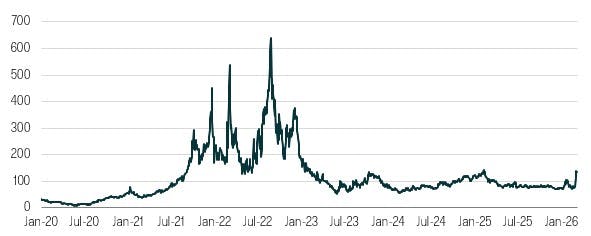
Geopolitics: energy prices spiking cause greater inflation risk
UK Natural Gas Price Futures price in sterling
National Average Price of a gallon of Unleaded Gasoline 2004 - current
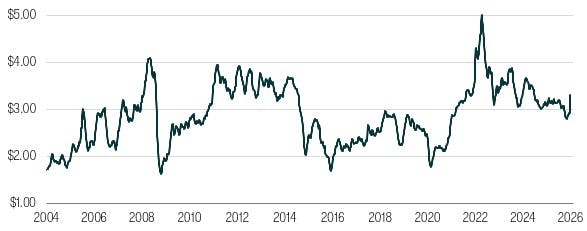
Source: Bloomberg, American Automobile Association AAA Fuel Prices W1M. As at 06.03.26
Expectations for future inflation rising sharply in UK and euro area
5-year inflation swap rate (%)
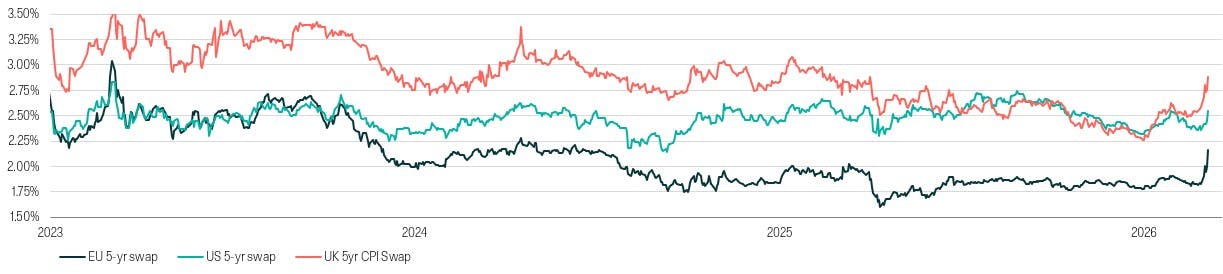
Source: Bloomberg, W1M. As at 06.03.26
Markets were expecting one or two small interest rate cuts in the US this year but the prospect of higher inflation has reduced that expectation to just one cut. The UK is now expected to have no further interest rate cuts. Clearly, there is a risk that rates could rise, if inflation becomes a bigger problem than expected, and that would be challenging for both equities and bonds.
Rate cuts expected in the US but not now in the UK
Implied US Fed funds rate
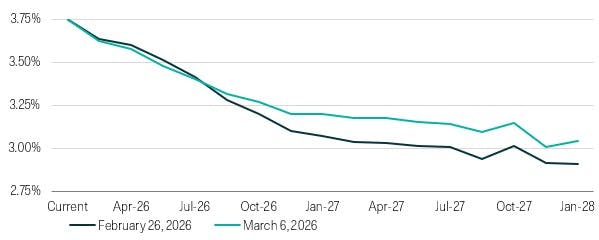
Implied UK base rate
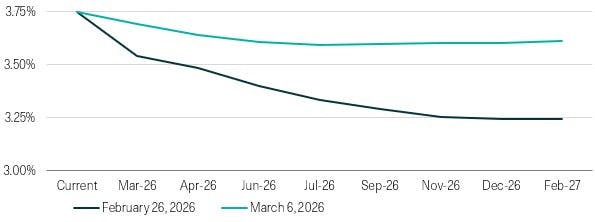
Source: Bloomberg, W1M. As at 06.03.26
Could passive funds have a "lost decade"?
There has been a strong run in equities for a long period and that always makes passive investing look successful, but passives do not always outperform. When, for example, some stocks become very successful and large in market capitalisation terms, equity indices go up and passive strategies can do well. Momentum can dominate fundamentals for a long time. However, in other periods, particularly when inflation is resurgent, equities and bonds can fall together which is damaging for passive “60-40s”. While they are normally expected to be diversifying, perhaps just when diversification is needed most, equities and bonds can be correlated, and both deliver negative returns; this was seen in 2022 when higher inflation surprised markets.
The chart below shows how a passive strategies can have very long periods when they deliver negative real returns; this may surprise many. It is easy to look at a long-term chart and say the shorter term does not matter but how long is the “short term? There have been long periods of passive strategies potentially being disappointing, such as post the dotcom crash and in the 1970s, in which investors would have been “underwater” for many years. This underlines the need to be more diversified than just holding equities and bonds in times of greater inflation risk.
Passive 60/40 portfolios have endured 6 "lost decades" since 1900; could we be entering no.7?
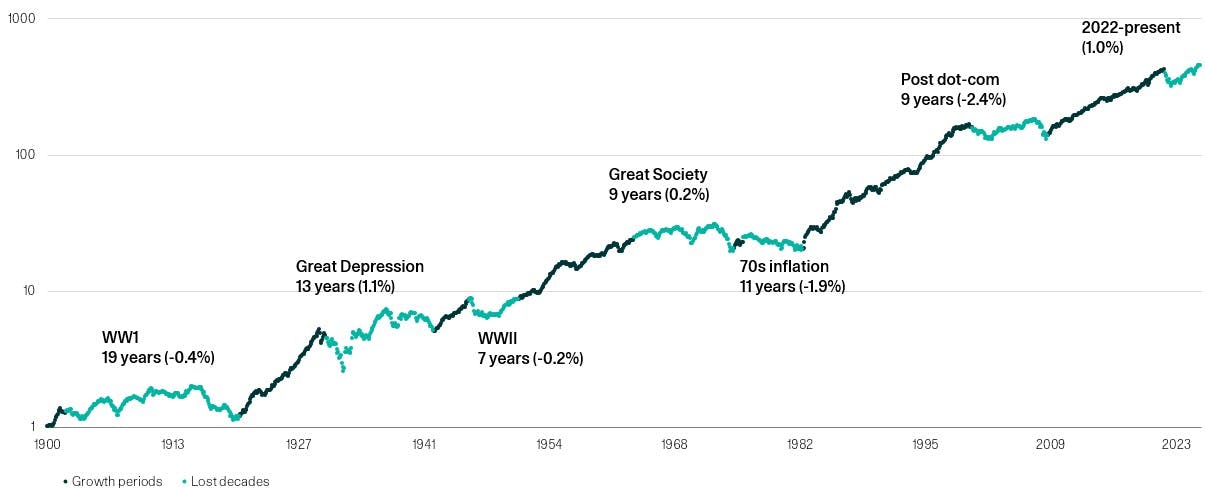
Source: BofA, Bloomberg. As at 31.12.25. Note: 60/40 = 60% S&P 500 real total return and 40% US 10-year bond real total return
Passive portfolios can sharply underperform in some environments. We may be entering such a period.
Equity markets have a degree of vulnerability from “concentration” which describes the situation when a few stocks have grown so large that they dominate the market capitalisation of indices. With the importance of the US equity market within global equities, having around a third of the US market concentrated in a small number of technology stocks can be a risk; this is especially so when inflation and interest rates are worrying markets. “Growth” stocks can do extremely well with markets discounting future, expected returns by a given interest rate; if that rate rises (or does not fall as hoped), that has an impact on valuation calculations. Companies have the pressure of delivering earnings to justify their valuations; interest rates going the wrong way makes their task harder. In this kind of environment, being global, active and direct in equity portfolios makes sense to us; we do not own every stock in the index but choose a portfolio of stocks to meet the medium-term risk adjusted returns of clients. The chart below explains how we think about stocks as “compounders” and “improvers”. We invest in companies where the market underappreciates the quality of the business. This can either be the long-term sustainability of high returns or the improving fundamentals. We call these “Compounders” and “Improvers”. Each stock we own has a 3-5 year thesis attached to it. Market corrections are largely an opportunity to add to stocks we really want to own for the medium to longer term.
Active Stock Selection is more important when market indices are concentrated
We invest in companies where the market underappreciates the quality of the business. This can either be the long-term sustainability of high returns or the improving fundamentals. We call these “Compounders” and “Improvers”.
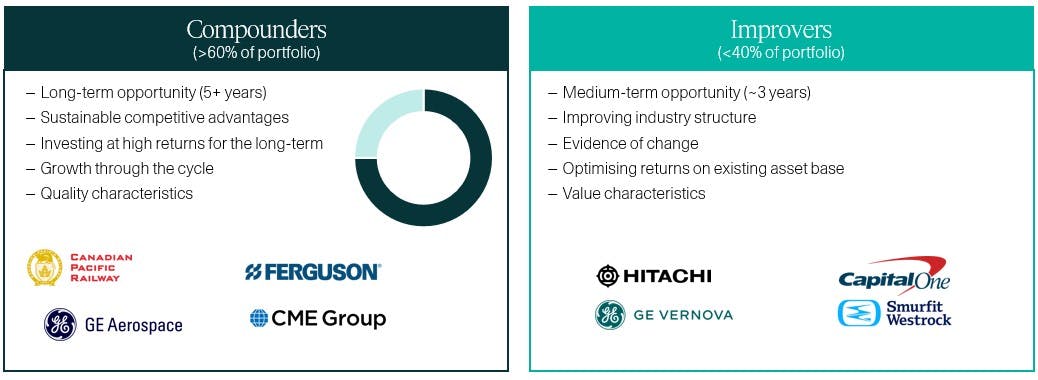
Source: W1M, Google Images. As at 31.12.2025
Real Assets: Inflation Resilience Qualities
Demand for real assets, like gold, has increased with inflation resilience being more valued and investors also wanting protection against fiat currency debasement (money printing). Real Assets are not just about gold but also the electrification of transport and manufacturing which leads to structural demand growing for copper and other metals. Greater demand for electricity means more interest in uranium as nuclear power becomes more important for environmental and energy independence reasons. Inflation resilience comes from resource sector profitability being sensitive to rising costs; if commodity prices do not rise when wage and energy price inflation is an issue, miners, for example, tend to have to reduce production or make losses and that is not sustainable in the long run.
Long term commodity cycle showing signs of recovery
U.S Commodity Price Index (data 1795 to present) with major inflation peaks (red dots) and major inflation troughs (orange dots)
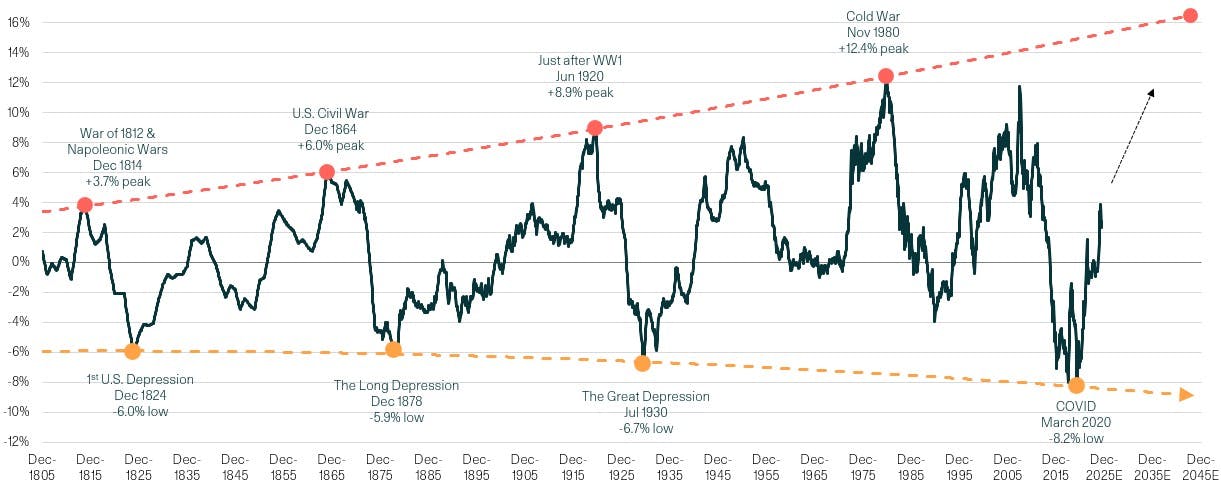
Source: Stifel, W1M, Bloomberg. As at 31.12.25.
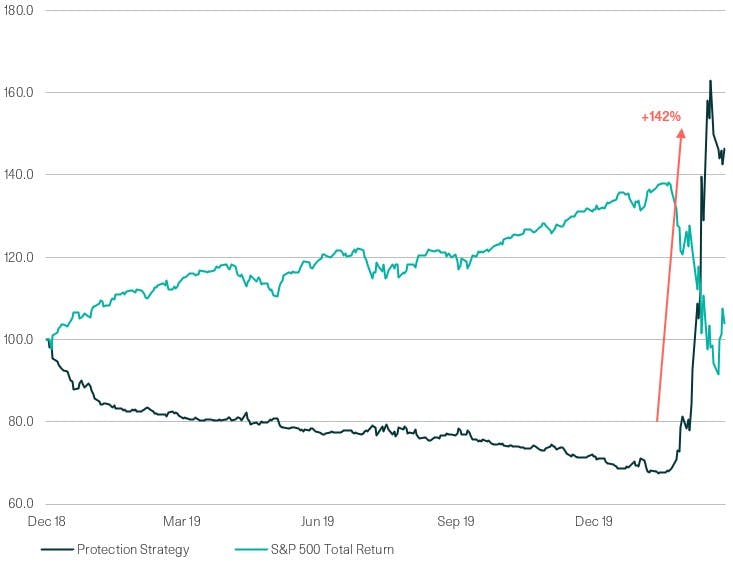
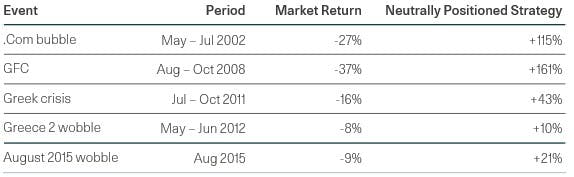
Protection Strategies: building resilience into our multi asset solutions is a key part of our process. Should market volatility increase, causing for example a significant equity sell off, protection strategies are designed to mitigate negative impacts, i.e. move the other way to equities. If sterling and US equities moved in ways unhelpful to our portfolios, we have strategies designed to ameliorate the situation. Protection strategies can be thought of as “taking insurance” against specific risks.
If you expect Volatility, do you have a Protection Strategy? How Did it Perform During Covid-19 Crisis?
Actual PS performance vs S&P 500 (TR)
Back-tested returns in previous crises
*Inception: 19th April 2016 Data to from 31.12.19 to 31.03.20
Source: Goldman Sachs, Bloomberg, W1M.
Figures are calculated on a total return basis, net of fees.
There is always a reason not to be invested. When considering the market impacts of the current middle east crisis, we are thinking about whether there is short-term stress in markets or long-term damage. A long conflict which results in higher energy prices sustaining, pushing inflation up and forcing interest rate increases, is a possibility but, at this point, avoiding that seems to be in both US and Iranian interests. After a volatile 2025, given new geopolitical stresses already this year, it is easy to become gloomy but the big picture, global growth and interest rate prospects, still remain constructive. In the long run, investors have done well by not being too driven by what is on the news. It is important not to panic but have a disciplined process when markets are chaotic. Companies globally are still expected to grow their earnings this year and next; interest rates are still set to be stable. Being active in portfolios is obviously valuable in times of market nervousness; we are able to make portfolios more defensive if necessary; we can also take opportunities which result from markets getting fearful despite longer-term prospects remaining positive. Keeping a medium to longer term perspective is important.
There’s always a reason not to be invested…
“Climbing the wall of worry”
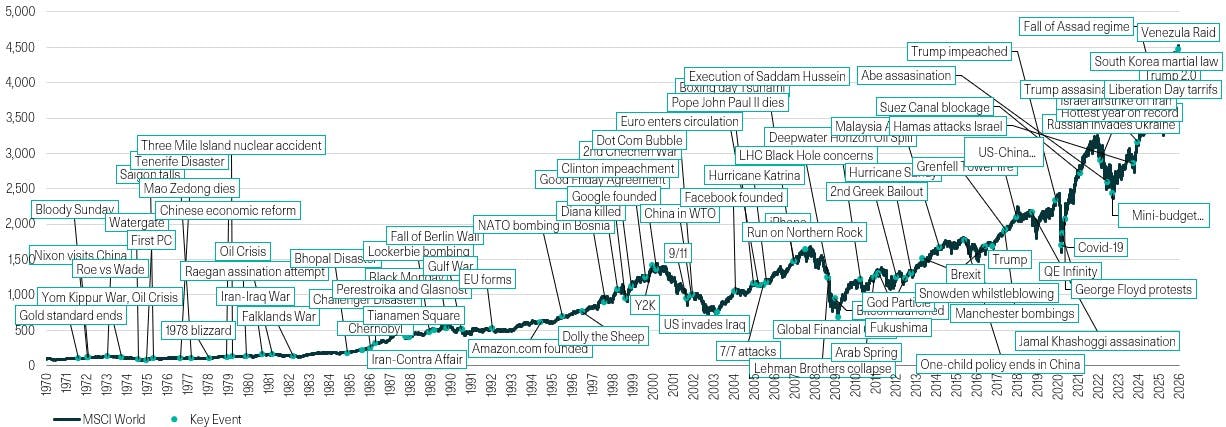
Source: Waverton, Bloomberg. As at 26.01.26.
Summary of our views
March 2026 Asset Allocation Positioning
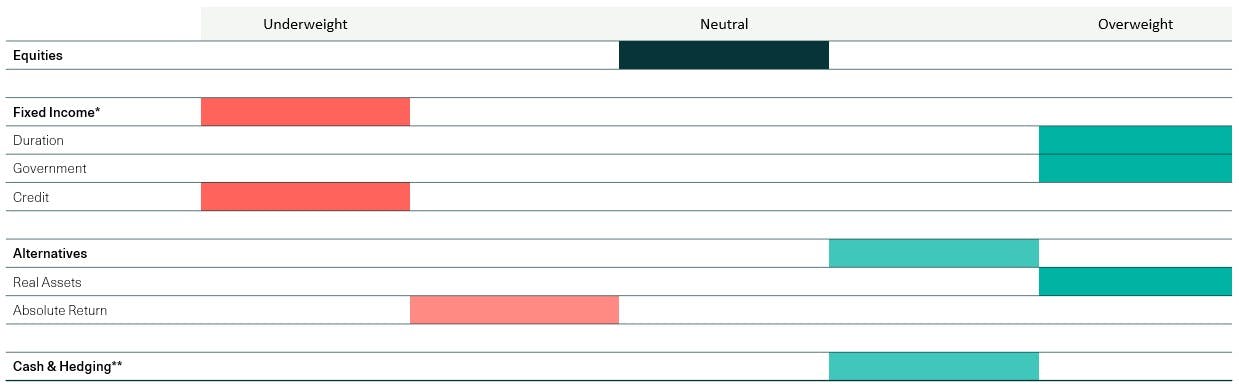
*The table shows bond allocations relative to bond composite index
**Hedging includes gold & Protection Strategy if possible.
Source: Morningstar. As at 05.03.26. The weightings are calculated as a percentage of the Waverton Balanced platform model portfolio and the peer group equivalent of Model GBP Allocation 40-60%. MSCI AC World weighting assumes a 60% allocation to equity. The above should be used as a guide only and is subject to change.
Conclusion
Energy prices spiking and greater inflation risk being present is a risk to both equity and fixed income markets. Interest rate cut expectations have already diminished as a result. Given greater inflation risk, we remain underweight fixed income, but retain a preference, within it for UK government bonds (gilts) relative to corporate debt. Owning every stock in the major indices, regardless of valuations, is not necessarily a good strategy, especially when some stocks are pricing in incredible growth and are sensitive to interest rate expectations. We remain convinced it is right to be active in an environment where a small number of stocks now represent a significant part of the total market and when geopolitical risks persist; our long term track record through various cycles shows the potential value of being active in equity investing. We are neutral in equities at the portfolio level but still find good ideas globally. Real assets offer diversification and inflation resilience which are now more needed as a result of geopolitical events. Proprietary protection strategies are a valuable and distinctive component of our portfolios in an uncertain world. While markets are volatile in a geopolitical crisis, the key thing is to assess whether the medium and longer term prospects are being damaged or not. The longer conflict continues, the more risk there is to the medium-term growth and inflation picture. But, for now, we still have a constructive environment expected into next year as market consensus believes finding an “off ramp” to end the war is in both US and Iranian interests. Clearly, events can change economic prospects significantly and it is key for investors to be properly diversified but also active in the current environment.
Chief Investment Officer, Bill Dinning's March Global Outlook can be found here.
Past performance is not a reliable indicator of future results. The value of investments and the income derived from them may rise as well as fall, and investors may not get back the amount originally invested. Capital security is not guaranteed.
This material is provided for informational purposes only and does not constitute investment advice or a recommendation. It should not be considered an offer to buy or sell any financial instrument or security. Any investment should be made based on a full understanding of the relevant documentation, including a private placement memorandum or offering documents where applicable. W1M Wealth Management Limited is authorised and regulated by both by the Financial Conduct Authority of 12 Endeavour Square, London E20 1JN, with firm reference number 120776 and the U.S. Securities and Exchange Commission of 100 F Street, NE Washington, DC 20549, with firm reference number 801-63787. Registered in England and Wales, Company Number 02080604.
All rights reserved. No part of this publication may be reproduced, distributed, or transmitted in any form or by any means, including photocopying, recording, or other electronic or mechanical methods, without prior written permission from W1M Wealth Management Limited.
Copyright © 2026 W1M Wealth Management Limited.