Selling a property – currency and mortgage considerations

With ongoing interest-rate volatility and significant currency fluctuations, many homeowners are taking the opportunity to reassess their UK property position. For US citizens living in the UK, this review is particularly important, as property decisions often carry unexpected cross-border tax consequences.
Ed Johnson and Tahir Mahmood explore some of the key considerations for US citizens who are thinking about selling a UK property.
Mortgage rates
In response to persistent inflationary pressures, the Bank of England has increased interest rates materially over recent years. As a result, borrowing costs have risen, particularly affecting those on variable-rate mortgages or whose fixed-rate deals are coming to an end.
Individuals on long-term fixed rates may not feel an immediate impact. However, for others—especially those with larger mortgage balances—higher interest rates can place pressure on household cash flow. This often prompts a broader review of whether a property remains sustainable, or whether alternatives such as refinancing, downsizing, or selling should be considered.
For US citizens, this decision should never be made based on UK considerations alone.
Selling a property in the UK
UK rules
In the UK, individuals benefit from Principal Private Residence (PPR) relief. This allows individuals to sell their main home and pay no capital gains tax, assuming all the necessary conditions are met.
US rules
US citizens, however, are subject to US tax on their worldwide income and gains, regardless of where they live. As a result, the sale of a UK main residence may still give rise to a US capital gains tax liability.
Currently, up to $250,000 of gain per individual (or $500,000 for married couples filing jointly) may be excluded from US taxation, again provided certain basic tests are met. Any gain more than this threshold is taxable in the US.
Crucially, the US tax calculation must be performed in US dollars, which introduces a further layer of complexity.
Currency effect
With the recent swings in currency, it is imperative that you understand the implications to you.
UK Property
By way of a high-level example, let's assume a US individual and taxpayer owns a house in the UK purchased for £2,000,000:
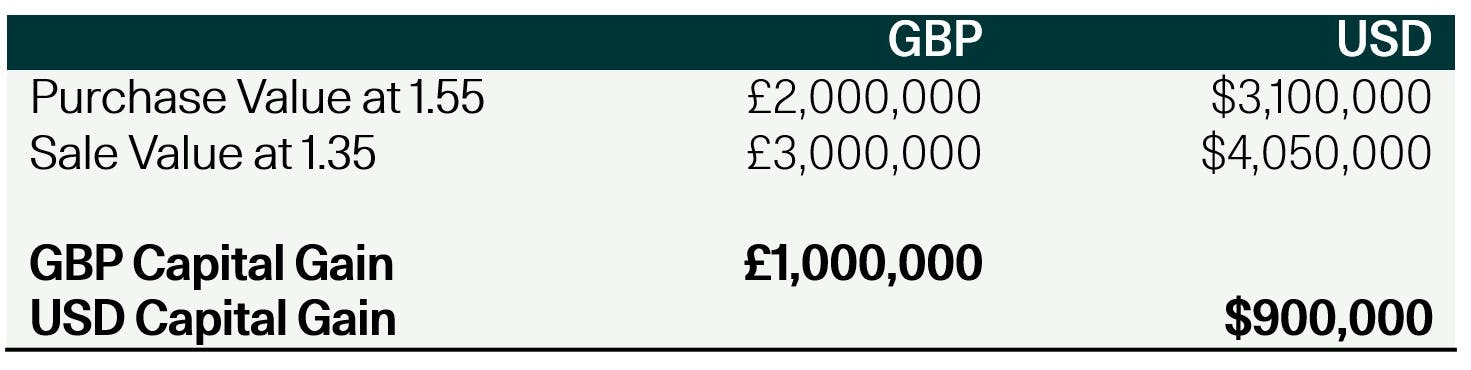
Although the GBP has depreciated against the USD in the above scenario, due to the UK’s Private Residence Relief, no capital gains will be due from HMRC’s perspective. Whilst there has been some depreciation in the currency from 1.55 to 1.35, there is still a USD capital gain of $900,000. After deducting the $250,000 primary residency exclusion, there is still a taxable long-term capital gain of $650,000 for US purposes.
Phantom mortgage gain - What is it?
Mortgage gain
Quite surprisingly, the potential pitfalls don’t stop there. If a mortgage is held, you might naturally assume that the debt is deducted from the asset value to reduce the potential gain. However, the mortgage is in fact considered separately to property.

The IRS, interested only in USD equivalent values, will view the above scenario as an individual having taken out a mortgage of $1,700,000 only to have repaid $1,150,000 at a later date and thus benefitting from repaying a lower amount (in USD terms) than initially having taken out and this will be subject to US tax at ordinary income rates.
Mortgage loss
Unfortunately, the bad news doesn’t end there.
If the above scenario is reversed, i.e., initial mortgage of £1m was taken out at a GBP/USD rate of 1.15 and later repaid at 1.70, the $550,000 ‘phantom loss’ in this instance, is viewed by the IRS as a ‘personal loss’ and as such, not deductible.

Clearly, careful attention and planning needs to be paid when considering capital repayments of outstanding debt.
Key takeways
Before selling a UK property, US citizens should carefully consider:
- The timing of a sale in light of exchange rate movements
- Whether mortgage debt could give rise to a phantom FX gain
- How gains will be calculated in both GBP and USD
- Whether both spouses’ US capital gains exclusions can be utilised
- The importance of pre-sale tax modelling before exchange of contracts
What appears to be a straightforward UK property transaction can carry complex and costly US tax consequences. Obtaining coordinated UK and US tax advice before acting can help avoid unexpected outcomes and ensure decisions are made with full visibility of the cross-border implications.
This material is provided for informational purposes only and does not constitute tax, legal or financial advice and should not be relied upon as such. W1M and our affiliates do not provide legal or tax advice. Investors should consult their financial and tax advisors to assess the tax implications of any investment. Tax treatment depends on the individual circumstances of each client and may be subject to change in the future.
The views expressed reflect current market conditions and are subject to change without notice. Any references to taxation are based on current understanding and may change.
This material is provided for informational purposes only and does not constitute investment advice or a recommendation. It should not be considered an offer to buy or sell any financial instrument or security.
Any investment should be made based on a full understanding of the relevant documentation, including a private placement memorandum or offering documents where applicable.
W1M Wealth Management and its affiliates do not provide legal or tax advice. Any references to taxation are based on current understanding and may change. Investors should seek independent tax advice tailored to their individual circumstances.