Oil above $100: Inflation shock or growth trap?

The price of oil has risen sharply since the outbreak of war involving Iran, lifting WTI crude from around $60 to over $100 per barrel. Moves of that magnitude rarely stay confined to the energy complex. They spill into inflation expectations, bond yields and risk appetite, often via the same simple channel: higher energy prices act like a tax on consumers and a cost shock for businesses. Markets have responded in the familiar pattern; near‑term inflation fears lift front‑end interest rate expectations, while growth concerns tug the other way. The result is heightened volatility across bonds, equities and FX, and a renewed debate about whether central banks will “look through” the supply shock or feel compelled to react.
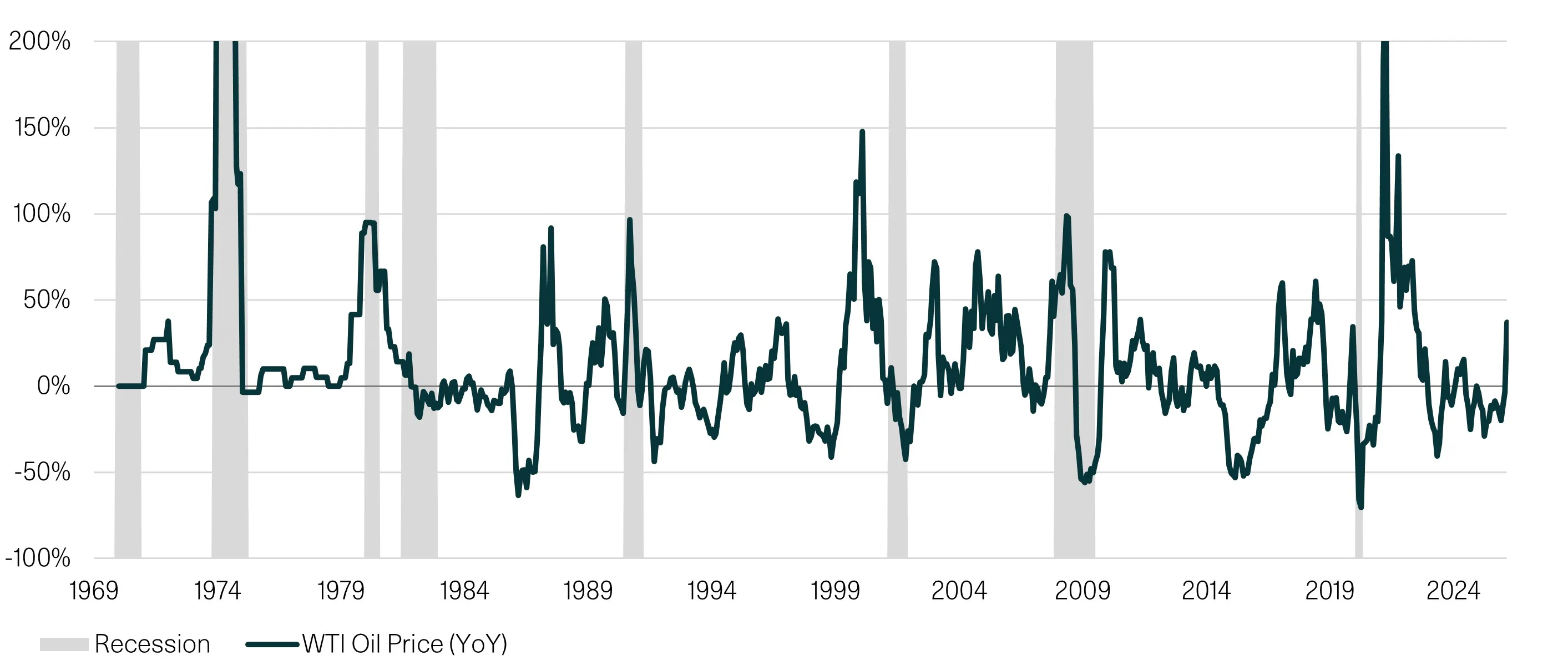
Oil spikes often coincide with recessions – WTI spot oil YoY change (USD/barrel)
Source: Bloomberg, W1M. Data as at 27 March 2026.
History is a useful guide. The 1970s remain the classic cautionary tale: repeated oil shocks (Yom Kippur War oil embargo in 1973 and the Iran Revolution in 1979) collided with wage indexation, weaker policy credibility and accommodative fiscal backdrops, contributing to entrenched inflation and ultimately very high interest rates. For markets, that era delivered poor real returns across both bonds and equities until central banks regained control. The key lesson is that second‑round effects (wages and pricing behaviour) matter more than the first‑round jump in headline inflation.
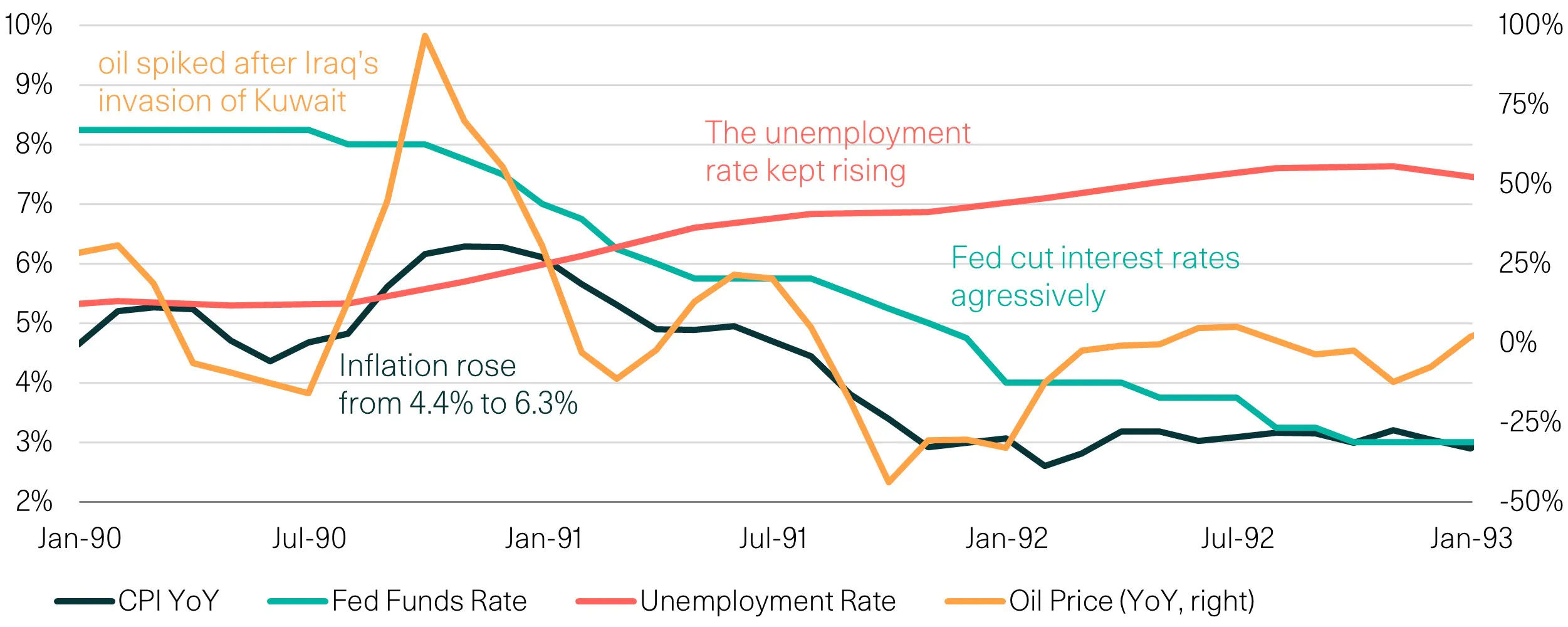
The 1990 Gulf War shock is a more relevant case study. Following Iraq’s invasion of Kuwait, oil jumped quickly, consumer confidence weakened, and growth rolled over. Importantly, once the slowdown became evident, the Federal Reserve eased policy despite the inflation impulse, because the growth hit and labour market deterioration became the dominant risks. That episode underlined a recurring pattern: when an oil spike materially dents demand, it can end up being disinflationary over the medium term even if it lifts headline inflation in the short run. Markets often oscillate between these narratives of inflation and growth, creating the kind of rate volatility we are seeing again today.
1990 Gulf War impact on oil prices, inflation, unemployment and interest rates
Source: Bloomberg, Federal Reserve, Bureau of Labor Statistics, W1M. Data as at 27 March 2026.
The 1990-91 recession was not wholly sparked by the oil price shock. Other factors including overextended private sector balance sheets, the saving and loan crisis, tight monetary policy and falling property values all contributed. These conditions are not in place today. Further, the oil intensity of GDP (oil consumption required to produce $1 GDP) has fallen considerably over the last three decades, moderating the economic impact of an energy shock today compared to the 1990s. Still, prolonged higher energy costs will drag on consumption, corporate profitability, and ultimately the demand for labour.
Nevertheless, if we have to pick an analogue for today, 1990 is a better fit than the 1970s and 2022. Today’s shock is primarily an exogenous energy supply disruption. By contrast, the 2022 inflation spike was a “double whammy” as post‑Covid supply constraints collided with a powerful demand rebound, boosted by pent‑up savings, alongside a major energy squeeze after Russia’s invasion of Ukraine. Substantial government support to households and firms then helped keep sustain aggregate demand, whilst labour markets were extremely tight, allowing inflation to spread well beyond the energy complex, into broad services and wages.
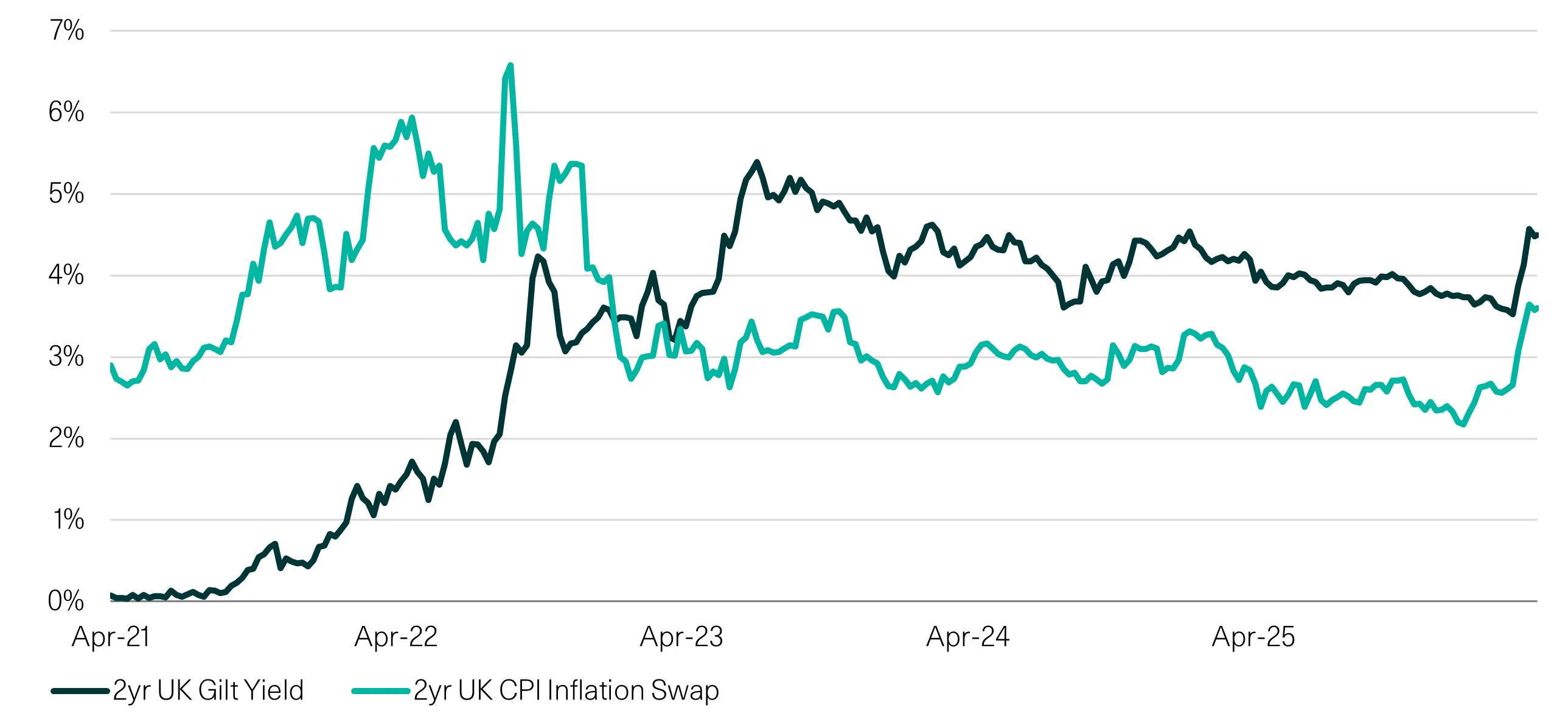
This time, the odds of those second‑order effects look lower. The broad post‑Covid stimulus and sweeping energy support packages of 2022 are politically and fiscally harder to repeat, so support is more likely to be limited and targeted. Labour markets also look less tight, which reduces employee bargaining power and makes wage growth less responsive to a temporary rise in headline inflation. Further, as the Russia-Ukraine war fuelled the energy price spike, policy rates were still near the zero-bound and inflation was already running hot; in February 2022 as the oil price surged through $100 per barrel, BoE Bank Rate was just 0.5% and UK CPI was already running over 6% YoY. The behavioural starting point is also different: inflation psychology is already sensitive, so confidence can fall faster, which restrains spending sooner and, ironically, helps limit persistent inflation.
UK 2yr gilt yield vs 2yr UK CPI inflation swap
Source: Bloomberg, W1M. Data as at 27 March 2026.
Central banks will want to avoid a replay of 2022, when inflation expectations threatened to de‑anchor. That is why messaging has turned more vigilant. The Bank of England’s tone following the latest MPC meeting was case in point: it signalled readiness to act, and the market has rapidly priced a more hawkish path. In our view, this is as much about influencing behaviour as it is about pre‑committing to hikes. If households and businesses believe policy will lean against inflation, they tend to be more cautious on wages demands and pricing – and that itself can reduce the need for significantly tighter policy.
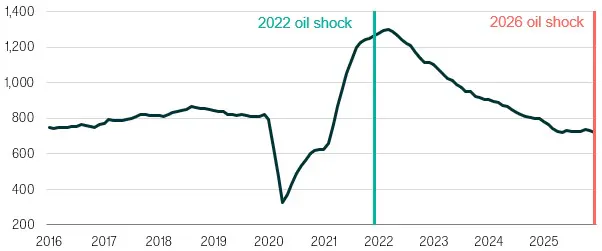
That doesn’t mean the BoE (or others) will ignore the shock. If oil stays elevated and inflation expectations climb meaningfully, the textbook response is to tighten. But there is also a genuine policy mistake risk in treating a supply shock like a demand boom. Higher energy prices squeeze real incomes and can be deflationary for other goods and services by pulling spending power away from the rest of the economy. With labour markets showing more slack, the hurdle for a wage‑price spiral looks higher than it did in 2022.
UK job openings (thousands)
Source: Office of National Statistics, W1M. Data as at 27 March 2026.
From a fixed income perspective, what matters is not whether inflation prints tick higher next month, but whether market pricing already reflects the plausible range of outcomes. The sharp repricing in yields suggests a lot of bad news is being discounted. We think the yield move has more than priced the risk that central banks deliver a meaningfully more hawkish path than investors were expecting before the conflict. That is why we remain broadly constructive on duration (sensitivity to interest rates). Even in a more prolonged energy shock, recession risks typically rise, and bond markets tend to refocus from “inflation now” to “growth later”. For long‑term investors, episodes like this often create opportunities to lock in more attractive yields than were available earlier.
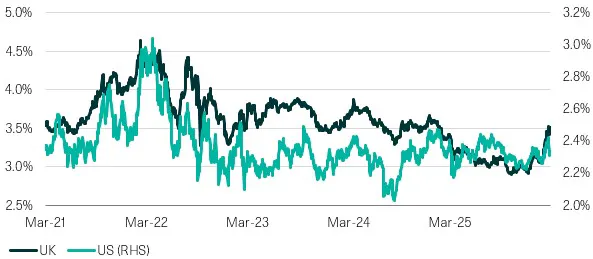
We have increased exposure to 10-year inflation‑linked bonds in portfolios. Real yields of around 1.5% in the UK and 2.1% in the US provide a genuine return above inflation, while breakeven rates of 3.5% and 2.3% respectively imply relatively modest inflation expectations. This creates upside if inflation proves more persistent, with a strong real‑yield cushion should it not.
UK and US 10-yr inflation breakeven rates
Source: Bloomberg, W1M. Data as at 27 March 2026.
At these levels, breakevens look attractive, while real yields offer a meaningful cushion against monetary policy uncertainty. For non‑US dollar‑based investors, Treasury Inflation‑Protected Securities (TIPS) also bring an additional portfolio benefit: the US dollar has historically behaved as a safe‑haven currency during exogenous shocks. The US is more energy self‑reliant than many peers, with domestic gas prices remaining comparatively subdued, which should leave the dollar better insulated in the event of a prolonged conflict. Taken together, US TIPS provide a sensible way to maintain inflation resilience while retaining exposure to interest rates. This should help to protect portfolios if the market’s focus shifts from inflation back towards growth over time.
Past performance is not a reliable indicator of future results. The value of investments and the income derived from them may rise as well as fall, and investors may not get back the amount originally invested. Capital security is not guaranteed.
This material is provided for informational purposes only and does not constitute investment advice or a recommendation. It should not be considered an offer to buy or sell any financial instrument or security. Any investment should be made based on a full understanding of the relevant documentation, including a private placement memorandum or offering documents where applicable.