Market Perspectives January 2026

View the full PDF document including total return indices, click here.
The Outlook for Interest Rates
The Bank of England cuts rates again.
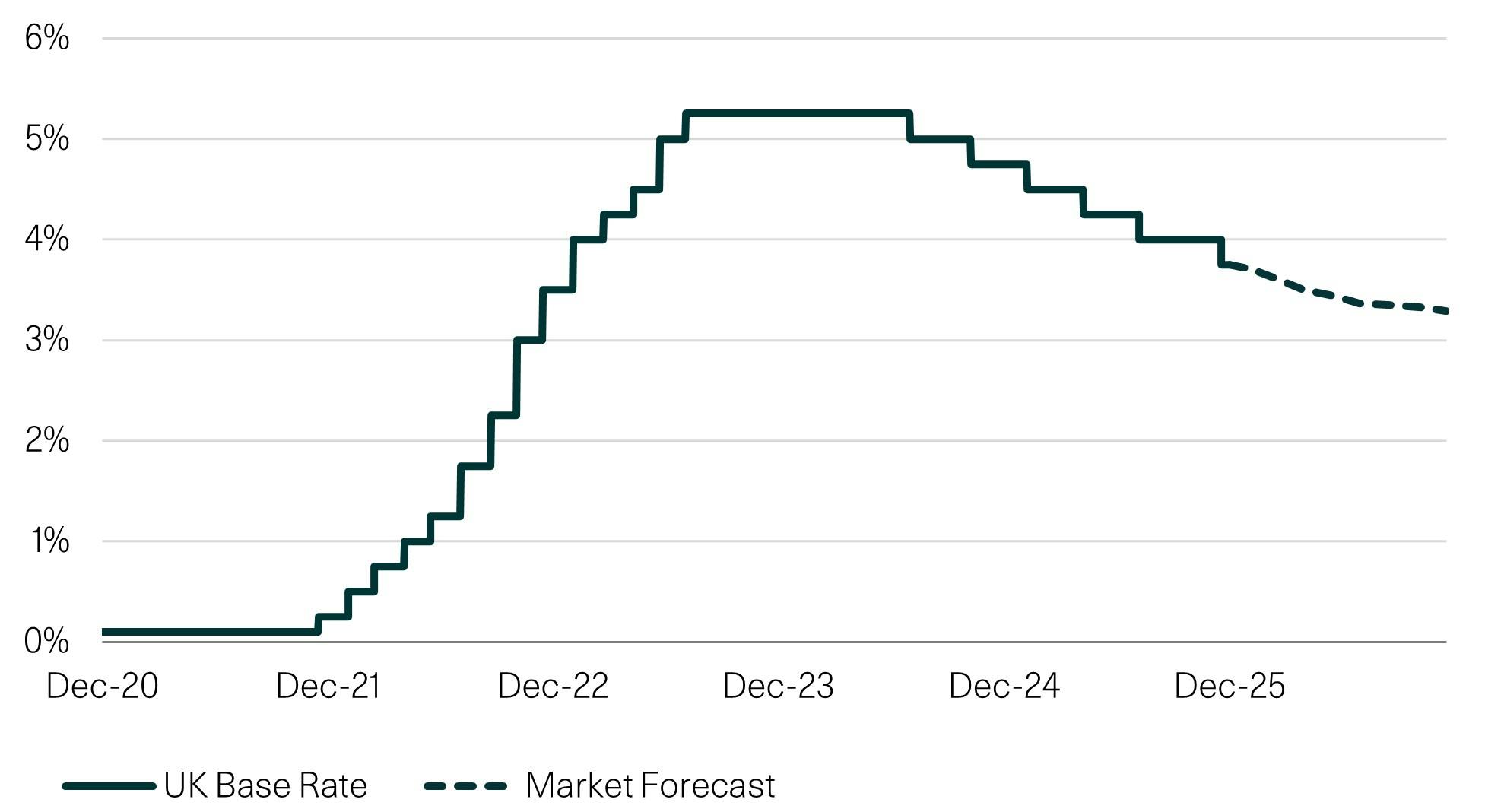
In late December the Bank of England cut the Base Rate to 3.75% – bringing the total number of cuts in 2025 to four. Interest rates are now a full 1.5% below their 2023-24 peak, and the post-Covid increase in inflation, which was exacerbated by the impact of the war in Ukraine on energy prices, continues to subside: whilst still uncomfortably high, the most recent CPI print (3.2% in the year to November) was below expectations. Encouragingly, core CPI (i.e. excluding volatile food and energy prices) was down to 3.2%, and services inflation also fell markedly. There are good reasons to believe inflation will fall further over the next six to twelve months: in the spring Ofgem’s energy price cap should fall and the government has recently signalled the removal of certain green energy levies from consumers’ bills. Moreover, a weakening labour market in the form of rising unemployment and slower wage growth, combined with an increasing tax burden, should keep the lid on wider inflationary pressures in the economy.
There are more cuts on the way.
Consequently, the gilt market is now discounting a base rate of c.3.3% by the end of 2026 – i.e. definitely one more 0.25% cut this year, and in all likelihood two. We believe that the neutral rate of interest (the rate at which savings and investment are in equilibrium) in the UK at present is around 3%, which is a bit lower than what is indicated by the market. Accordingly, we remain positive on UK gilts relative to some other bond markets because we feel that there is more scope for rates to come down than is currently discounted. Gilts have in fact performed quite strongly over the last quarter, with the 30-year yield falling from 5.5% to 5.2% – but we think there is more to go for. Our caution about the outlook for UK economic growth gives us confidence in this analysis, and the government’s determination to stick to the OBR’s fiscal rules makes the UK look more disciplined in its budgeting than North America, Europe or Japan. That said, the long term sustainability of any of these governments’ finances looks decidedly shaky, which leads us to be underweight the fixed interest asset class as a whole.
Precious metals are doing well.
Investors have been looking for alternative safe havens ever since US treasuries and the dollar fell sharply in the same week that the US stock market collapsed after ‘Liberation Day’ last April. This is no doubt one reason why precious metals have been performing so strongly of late, with silver and platinum prices in particular having surged towards the year end. However, it has not all been ‘plain sailing’ on that front: in October gold suffered its worst day since 2013 and the metal saw a further bout of volatility at the end of the year. Another asset which has been heralded as a potential safe haven from currency debasement, Bitcoin, fell 7% in US dollar terms in 2025 (and it was down 13% in sterling terms).
Long bonds are an important source of diversification.
The fact is, no single asset can be considered a cast iron all-weather safe haven – arguably not even cash when major risks are long term currency debasement and short term devaluation relative to other fiat currencies. The key is to have a mix of hedging instruments so that there is always a degree of inverse correlation in a multi-asset portfolio. Therefore, despite the concerns we have about the sustainability of government finances, long-dated government bonds do have a role in portfolios because there will be scenarios in which they do well whilst equities, corporate debt and real assets such as property are doing badly. A subdued outlook for economic growth in the UK, combined with falling inflation and lower base rates, does provide a reasonable underpinning for gilts at these levels, especially as the global backdrop is one of declining rates in most regions (the main exception being Japan).
UK Base Rate with Forecast (%)
Source: Bloomberg, W1M
The Outlook for Equities
The UK has apparently done well.
Although the UK economy is stuck in the slow lane, London’s stock market has been one of the better performing ones of 2025. Indeed, the FTSE100 index exceeded 10,000 points for the first time ever on 2nd January – and the UK market as a whole returned 24% in 2025. Rachel Reeves claimed this was a ‘vote of confidence’ in Britain’s economy. Unfortunately, however, that is unlikely to be the case as three quarters of the FTSE100’s revenue comes from outside the UK. The index is heavily concentrated in a few large international companies like Shell and AstraZeneca, both of which we hold because they are global leaders in their fields rather than bellwethers for the UK economy. The performance of domestic UK small caps has significantly lagged international large-cap indices.
The US has underperformed.
Continental Europe, Asia and Emerging Markets have also performed extremely well, so the real issue has been the underperformance of the US relative to other parts of the world. This is partly attributable to a decline in the value of the dollar, but more pertinently reflects a re-rating of stock markets outside the US; when it comes to earnings, the US has seen higher growth and more upgrades to forecasts than markets outside the US. In other words, the underlying fundamentals in the US continue to be strong, but ex-US stock markets have become more expensive, whereas the valuation of the US has stayed broadly the same over the last twelve months.
The growth outlook is good.
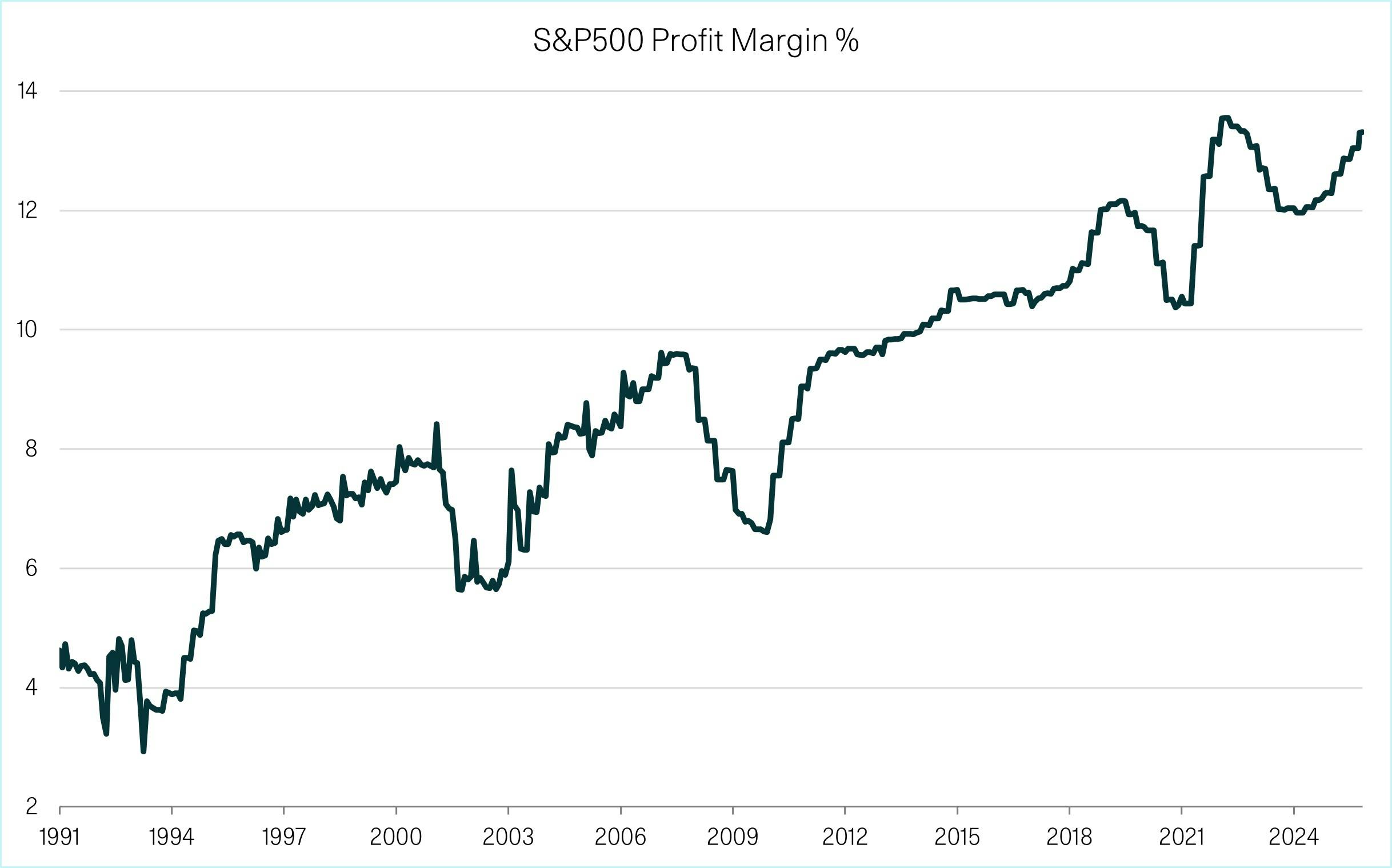
Loosening monetary policy and fiscal easing (especially in the US, Germany and Japan), combined with low oil prices, mean the outlook for global economic growth is quite strong. The US is well placed to capitalise on this as US corporate profitability is at an all-time high – and that in itself is usually a good indicator of benign economic conditions ahead because it supports employment prospects, capital expenditure and investor confidence. The big risks to this are probably China (where the ongoing property slump is constraining demand and causing stress in the financial system), a loss of confidence in a major bond market (e.g. Japan, where government net debt to GDP is c. 200%), and geopolitics. On the latter front, China is again as likely to be at the epicentre as anywhere else: the US / China trade war may only be in temporary abeyance, and both superpowers are becoming increasingly assertive in their own back yards – China in Taiwan and the US in Latin America. However, geopolitical risk can present upside as well as downside: peace in Ukraine and a thriving oil industry in Venezuela (though that must still be a long way off) would benefit the US consumer through lower oil prices.
US tech is no longer the only game in town.
One probable result of the broadening out of economic growth should be that returns are no longer so concentrated in the US tech sector, which has been a problem, on and off, for active managers these last few years. That the US tech sector has done incredibly well and looks expensive in aggregate is not a reason in itself to avoid it: if we can identify a resilient business model and sustainable cash flow growth, then we’ll back it – Microsoft being an obvious case in point. However, we do find ourselves becoming increasingly underweight technology by virtue of the fact that we are now finding better value elsewhere, both among old favourites like Visa and new ideas such as Shinhan Financial and Smurfit Westrock. It may be, therefore, that 2026 continues where 2025 left off – with the US stock market sustained by strong earnings growth (assisted by a weak dollar), and non-US markets driven by a continued gradual re-rating.
S&P500 Profit Margin (%)
Source: Bloomberg, W1M
Past performance is not a reliable indicator of future results. The value of investments and the income derived from them may rise as
well as fall, and investors may not get back the amount originally invested. Capital security is not guaranteed.
This material is provided for informational purposes only and does not constitute investment advice or a recommendation. It should not be considered an offer to buy or sell any financial instrument or security. Any investment should be made based on a full understanding of the relevant documentation, including a private placement memorandum or offering documents where applicable. W1M Wealth Management Limited is authorised and regulated by both by the Financial Conduct Authority of 12 Endeavour Square, London E20 1JN, with firm reference number 120776 and the U.S. Securities and Exchange Commission of 100 F Street, NE Washington, DC 20549, with firm reference number 801-63787. Registered in England and Wales, Company Number 02080604.
All rights reserved. No part of this publication may be reproduced, distributed, or transmitted in any form or by any means, including photocopying, recording, or other electronic or mechanical methods, without prior written permission from W1M Wealth Management Limited.
Copyright © 2026 W1M Wealth Management Limited.
Market Perspectives January 2026