China - "The reports of my death are greatly exaggerated”

This was reportedly the response of Mark Twain after reading his own obituary in his morning newspaper. This year we have been constantly reading articles giving an equally bleak prognosis for the investment outlook in China. In this piece we consider whether there are any signs of life for Chinese equities, or whether conditions are indeed terminal.
The Chinese economy is slowing and is beset by multiple challenges. Economic growth is being constrained by a real estate downturn, weakening consumer confidence and deflationary pressures. The economy is still expanding and consumer spending is still growing, but companies we speak with report an increasingly challenging operating environment. The government has responded with increasingly strong policy initiatives, but these have so far failed to revitalise confidence or correct underlying structural imbalances.
However we caution against drawing too straight a line between current economic challenges and the long-term outlook for equities in China. GDP growth in China has become a poor proxy for real world value creation because of a top-down economic growth model driven by increasingly unproductive capital investment. Rapid economic development in recent decades has not translated into attractive equity returns (below), indicating that there are other important issues at play in China.
MSCI China
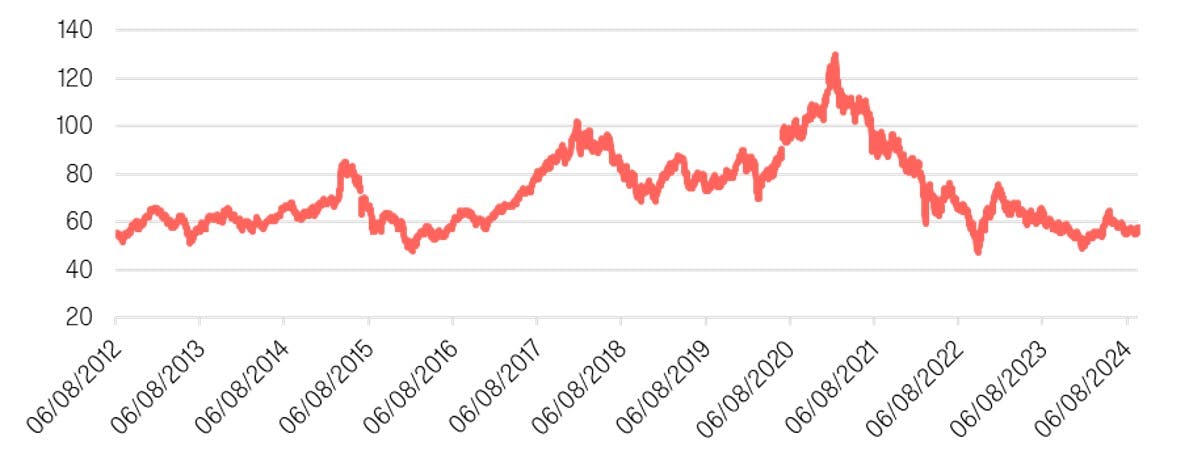
Source: MSCI
While a slowing Chinese economy creates headwinds for businesses, we feel that the greater challenges to long-term shareholder value creation are related to imbalances on the supply-side, and wide-spread misalignment with minority shareholders.
Low returns on invested capital are a function of too much supply, not too little demand
China’s high savings rate, over 40% of GDP, has facilitated an economic growth model underpinned by high levels of fixed asset investment, combined with state-sponsored allocation of capital towards political objectives. This supply-side driven model has created a tendency towards structural overcapacity in industries, as well as towards highly competitive industry structures. With so much supply chasing a finite level of demand, returns on invested capital have inevitably suffered. The consequence has been a poor long-term experience for the equity market.
Oversupply has depressed return on invested capital in many industries, and is also the root cause of many of today’s challenges. Over-investment into real estate has created an enormous inventory surplus, while excess capacity in priority sectors such as electric vehicles and solar panels is exacerbating global trade tensions. However, in response to the recent economic downturn, we are finding an increasing number of industries where supply is now shrinking and consolidating, as smaller and weaker operators get washed out, typically to the benefit of strong market leaders. As a consequence, these leading companies are able to continue growing operating profits from market share gains, while falling competitive intensity provides the scope for higher returns on capital. Within the Waverton Asia Pacific portfolio our Chinese investments benefit from attractive supply-side dynamics, operating in consolidating industries or in disciplined oligopolies. Our Chinese holdings are expected to grow operating income by +9% on average next year amid challenging economic conditions. Should the government’s increasingly large stimulus packages revitalise the demand side of the economy, there could be further upside to these growth numbers.
Shareholder alignment in China frequently falls short of our hurdle
The government’s pervasive involvement in industries (through regulation, SOEs and subsidised capital) often serves to subordinate shareholders’ interests in China. But following in the footsteps of Japan’s shareholder reorientation, the Chinese regulator has introduced guidance and incentives for companies to prioritise return on equity and share price performance. For the government, this encourages greater capital efficiency among SOEs at a time when the fiscal position has become increasingly constrained. These reforms are bearing fruit with total distributions to shareholders doubling since 2016, and with share buybacks in 2024 showing further growth.
Total Shareholder distributions in China
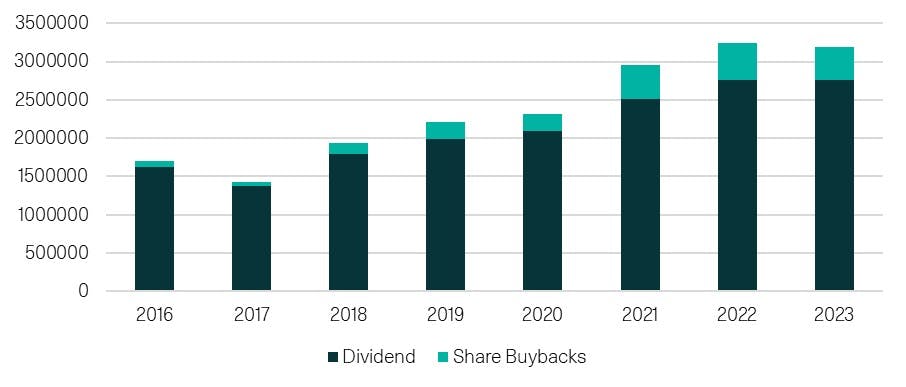
Source: Factset
This is a positive development in a market where shareholder orientation is often lacking. However we continue to steer away from SOEs within the Waverton Asia Pacific portfolio, recognising that state-directed shareholder-orientation may prove short-lived as political objectives inevitably change. Share buybacks also remain misunderstood by many Chinese companies we speak with; often with no acknowledgment of the relevance of share price in a buyback, or the need to cancel those shares to crystalise the benefit of having repurchased at a discount to intrinsic value. We instead focus on companies where founders and management teams own significant equity stakes themselves. This creates true alignment of interests and a long-term value creation culture. Our Chinese holdings are expected to repurchase 5% of their outstanding shares this year on average. This reflects both confidence in their own businesses, and the willingness to invest counter-cyclically using negative investor sentiment as a window of opportunity to create more value for long-term owners.
Combined with growth in operating profit, buybacks allows for “mid-teens” growth in earnings and free cash flow per share among our Chinese investments. This is further supplemented by an average dividend yield of 3.3%.
Valuations are now at extremely depressed levels
Investment capital has retrenched from China. Foreigners have been net sellers of equities to the extent that “ex-China” asset classes have emerged. Capital raising activity has also dried up with primary equity raises on the Hong Kong Exchange falling from HK$331.4bn in 2021 to HK$46.3bn in 2023. This investor exodus and the extreme of negative sentiment has caused a derating of the equity market to historic lows.
MSCI China
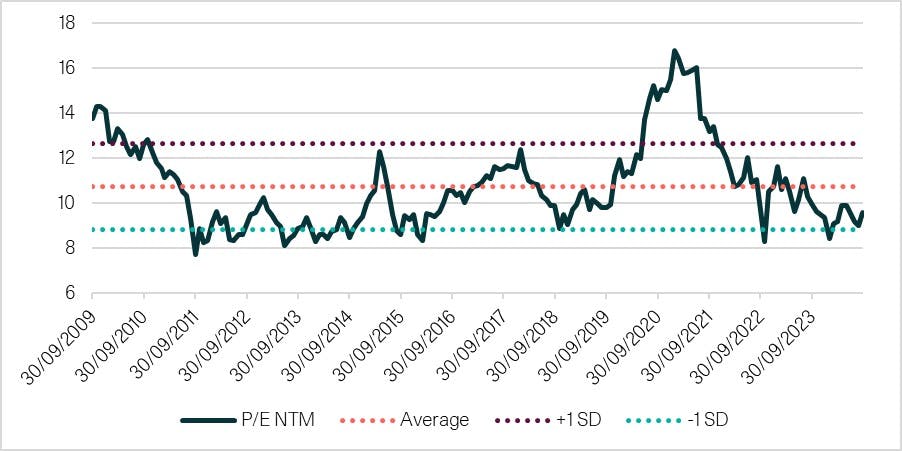
Source: MSCI
Chinese valuations have been highly volatile in the past as investors swung between extremes of optimism and pessimism. The fundamental opportunities and risks of investing in China have changed much less during that period. As a stock-level example, in 2020 Alibaba was valued at a peak EV/EBIT of 55x which has subsequently fallen to 8.5x today. Both of those strike us as extreme for a company whose fundamentals have changed only modestly. We also find it curious that many stocks listed outside of China which nevertheless have significant exposure to the market’s risks, appear to factor no “China discount” into their valuation (such as Apple or Nvidia).
As active investors we can benefit when valuations become detached from fundamentals. Our bottom-up approach, focussing on the supply-side, capital allocation and alignment, allows us to isolate companies in China where the fundamentals remain strong. Due to indiscriminate negative sentiment and economic uncertainty these companies are now priced at highly attractive valuations. It is too early to say whether the government’s increasingly large stimulus package will materially strengthen the economy or provide a permanent shift in consumer and investor sentiment. Either of these outcomes would provide additional upside to our expectations for our investments in China.
Past performance is not a reliable indicator of future results. The value of investments and the income derived from them may rise as well as fall, and investors may not get back the amount originally invested. Capital security is not guaranteed.
This material is provided for informational purposes only and does not constitute investment advice or a recommendation. It should not be considered an offer to buy or sell any financial instrument or security. Any investment should be made based on a full understanding of the relevant documentation, including a private placement memorandum or offering documents where applicable.