Carry & convexity: Opportunities in Emerging Market rates

After a strong rally in 2025, emerging market (“EM”) local currency bonds continue to offer attractive opportunities. While the drivers have evolved, the backdrop remains supportive. Our preference is to combine high real yields with convexity in economies where disinflation is advancing, central banks still have more room to ease than markets discount, and yield curves continue to compensate investors generously for taking duration risk.
Softer US Dollar driving disinflation momentum
One of the most important macro forces shaping emerging markets over the past 18 months has been the broad softening of the US dollar. Currency moves feed into inflation with a lag, particularly through import prices, and that lag is still working its way through headline and core inflation prints across much of the EM universe.
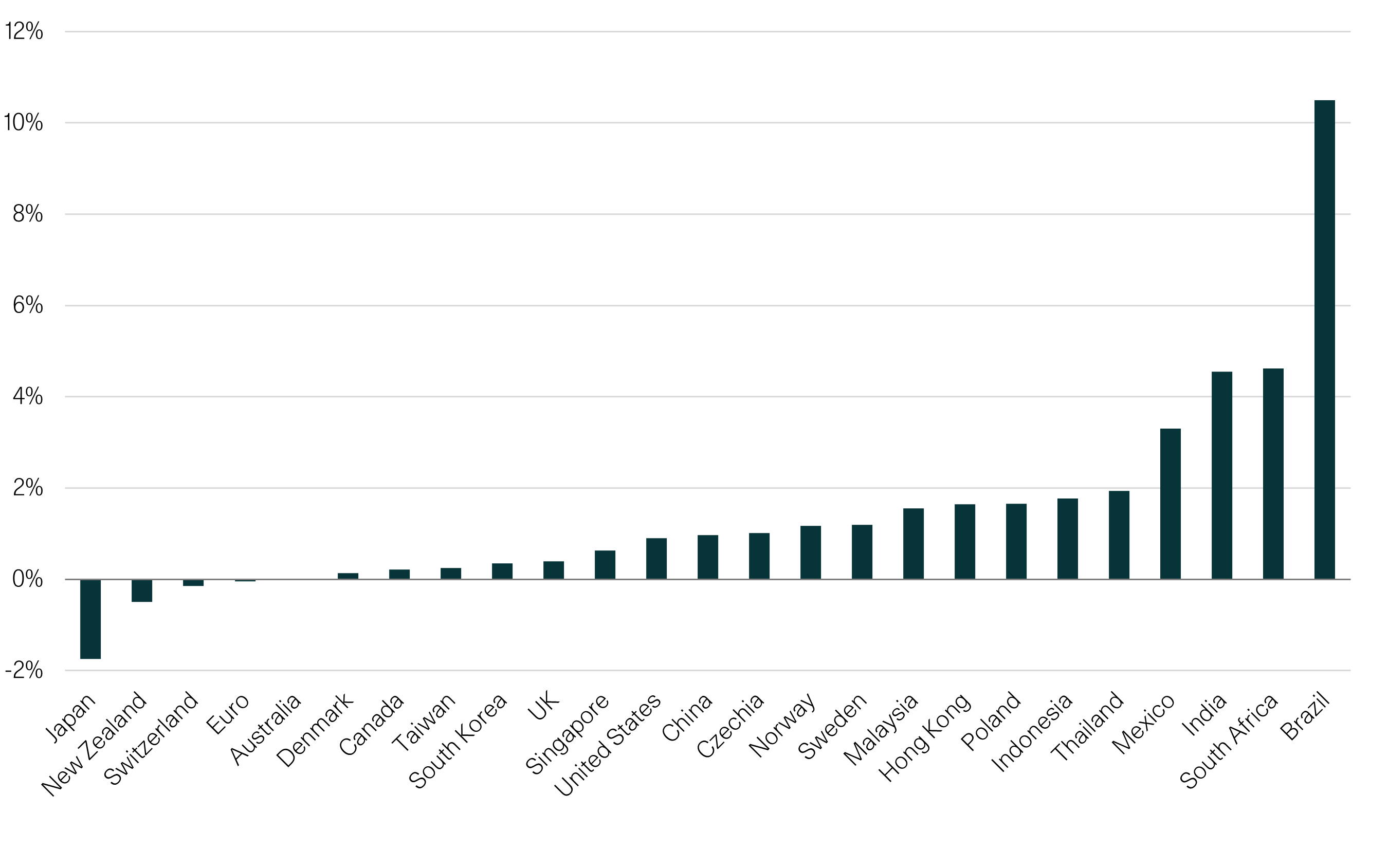
Even if the dollar were to stabilise from here, the disinflationary impulse is not over. In many emerging economies, inflation has already fallen back toward target while policy rates remain firmly restrictive in real terms. That combination of lower inflation and still elevated nominal rates creates scope for further easing that is not fully reflected in local yield curves.
Real Interest Rates (overnight interest rates less CPI)
Source: Bloomberg, W1M. Data as at 31 December 2025.
Beyond its impact on inflation, a softer US dollar is also supportive for EM through several additional channels. Lower dollar debt servicing costs ease financial conditions for governments, while historically a weaker dollar has tended to coincide with firmer commodity prices, providing a tailwind to growth and external balances across many EM economies. At the same time, periods of dollar weakness have often been associated with a rotation of US‑based capital toward international assets, reinforcing portfolio inflows into EM local markets. Together, these effects strengthen the macro backdrop and help sustain the conditions under which interest rates and bond yields can fall.
Calmer US rates volatility is a tailwind for EM
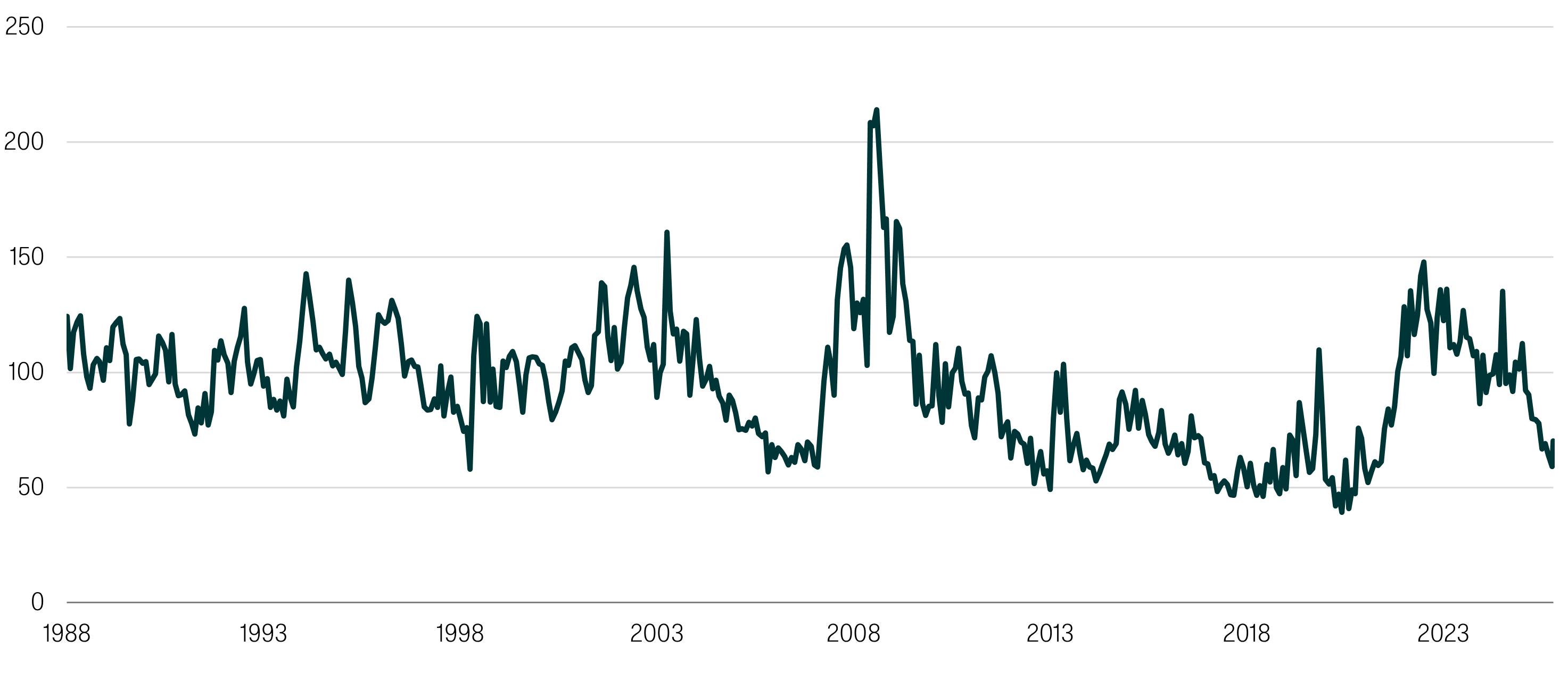
A second, underappreciated shift has been the decline in global rates volatility. As the Federal Reserve’s easing path approaches ‘neutral’ and tariff related inflation risks recedes, volatility in developed bond markets is falling. That matters for emerging markets. Lower volatility improves the risk adjusted returns from carry and gives EM central banks greater freedom to diverge from the Fed without triggering destabilising capital flows. It is in this environment that longer‑dated local bonds can deliver disproportionate returns, as either policy easing accelerates or term premia unwind.
ICE BofA MOVE Index (US bond market volatility)
Source: ICE BofA, W1M. Data as at 13 February 2026.
Selective opportunities
As easing cycles mature, the differentiation across emerging markets increasingly comes down to fiscal credibility and political dynamics rather than inflation alone. Several markets stand out where institutional credibility is on an upward trend and curves appear to be pricing too little easing:
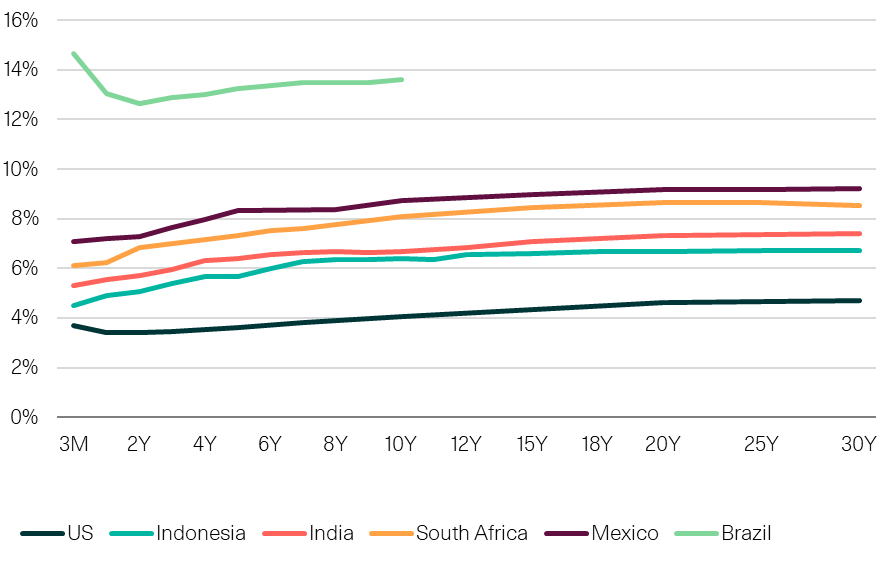
Mexico offers a clear example. The central bank is widely seen as nearing the end of its easing cycle, yet the yield curve remains steep. Inflation dynamics continue to improve, fiscal balances have strengthened, and the peso has remained resilient even through periods of global risk aversion. Against that backdrop, the curve implies a degree of policy restraint that looks increasingly difficult to justify – particularly as authorities engage proactively ahead of the upcoming USMCA review.
South Africa stands out for a different reason. At a time when many developed economies are expanding fiscally, South Africa is consolidating. Improved terms of trade, driven by higher precious metal prices, have strengthened the external position, while the central bank’s decision to lower its inflation target has yet to be fully reflected in long term pricing. The result is a curve that appears excessively steep relative to both the inflation trajectory and the fiscal path – offering meaningful upside if credibility continues to be rewarded.
Brazil continues to have one of the highest real policy rates in the world, providing both a buffer for the currency and substantial scope for further easing. Political noise will inevitably rise ahead of the presidential election, but the range of plausible outcomes appears narrower than in past cycles. Markets may also be underestimating the potential for post-election fiscal improvement.
India and Indonesia also look attractive from a real rate and currency perspective, though in those cases the opportunity is currently better expressed through FX rather than duration, as nominal bond yields remain less compelling.
Sovereign Bond Yield Curves (Local Currency)
Source: Bloomberg, W1M. Data as at 16 February 2026.
Portfolio implications
The most attractive opportunities today lie in markets combining high real yields, credible disinflation trends, relatively stable institutional frameworks, and yield curves that continue to offer generous compensation for duration risk. While short‑dated bonds still provide attractive carry, selectively adding long‑dated exposure can materially improve portfolio asymmetry, shifting returns more decisively toward rates rather than FX. We express this through zero‑coupon, AAA‑rated supranational bonds that trade at low cash prices, limiting upfront currency exposure while maximising convexity to changes in yields. This structure is complemented by attractive carry, which provides a cushion against interim volatility.
Conclusion
The current macroeconomic backdrop remains supportive for EM. The US dollar is unlikely to re‑enter a sustained strengthening cycle under the current administration, rates volatility is declining, and fiscal policy across much of the developed world is becoming more expansionary rather than less. In this context, the relative macro discipline of several emerging market issuers stands out. Strong performance in local markets over the past year has also reinforced positive reflexivity: inflows have followed returns, while the search for currency and geographic diversification remains a key theme for global investors. Taken together, these dynamics continue to underpin the EM local opportunity set.
During February, W1M actively increased exposure to this theme, with positions held in both the Waverton Sterling Bond Fund and the Waverton Global Strategic Bond Fund.
This material is provided for informational purposes only and does not constitute investment advice or a recommendation. The views expressed reflect current market conditions and are subject to change without notice.
All materials have been obtained from sources believed to be reliable, but their accuracy is not guaranteed. There is no representation or warranty as to the current accuracy of, nor liability for, decisions based on such information.
Investment strategies presented are not suitable for all investors and do not represent the experience of other clients. Results may vary and are subject to change based on market conditions and individual circumstances. Investors should consult their financial and tax advisors to assess the suitability and risks of any investment.
Portfolios may include investments in illiquid assets, securities subject to counterparty risk, and instruments sensitive to changes in exchange or interest rates. Derivatives such as futures, options, structured notes, and contracts for differences may be used for risk management or investment purposes but may also involve a higher level of risk and may not be suitable for all investors. There is a risk of loss and of counterparty default on such instruments.