Buddenbrooks investing: Living off the dividends without hollowing out the house

Thomas Saville reveals why focusing on total-returns pays dividends
“Living off the dividends” is a long-held conventional wisdom that still inspires prudent investment policy statements (IPSs). A vestige of private trust law (to stop Susan spending Steven’s inheritance) the theory holds that spending only natural income paid from a portfolio will guarantee the preservation of its capital value in real terms. The reality? In forcing natural income higher, prudent investment committees have realised negligently low total returns; thus living off the dividends while hollowing out the house.
The surprising persistence of such dogmatic delusions of conservatism is a theme explored by Thomas Mann’s Buddenbrooks. The story is an autopsy of the multi-generational decline of a Lübeck-bound merchant family. Cause of death? An obstinate attachment to respectability or soundness leading to the outright rejection of new ideas; an illusion of prudence resulting in reckless decline.
Sadly, the Buddenbrooks are not an isolated case. The despotism of custom has been the undoing of many wealthy aristocratic families. We believe the inherited concept of “living off the dividends” has also been a hindrance to charities for far too long. Thankfully, having neither wealth nor class, your author is unburdened by convention. What follows is an attempt to both admonish the use of natural income within investment policy statements and advise alternatives (all told through the lens of a nineteenth-century Hanseatic trading family).
Forgone growth and the decorum dividend
“The external, visible, tangible tokens and symbols of happiness and success first appear only after things have in reality gone into decline already.” Thomas Mann
A punctilious bookkeeper, timely bill-payer and immaculate dresser, Thomas Buddenbrook was the model charity trustee; at first glance at least. A deeper examination reveals an all-too-common ailment. Thomas’s conservatism, his focus on the respectability of timely payment and his reluctance to evolve and reinvest in the family business, eventually undermines the sustainability of his family’s stipends.
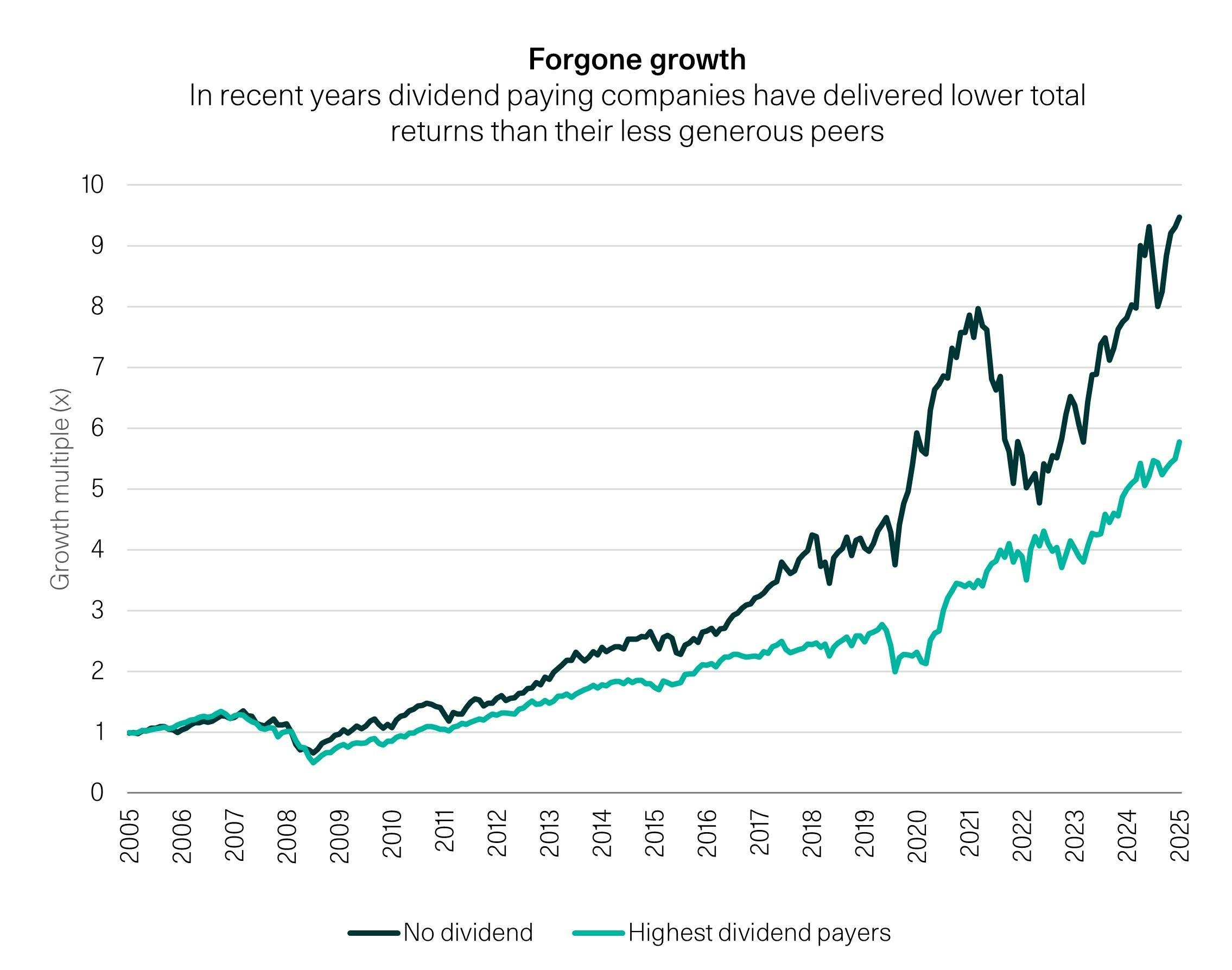
Capital allocation is always a compromise, and the companies we examine on our clients’ behalf face the same conundrum. Every penny paid to investors is a penny not available to reinvest for future growth. The obvious corollary for trustees is that asking for higher-yielding portfolios has a knock-on effect on future capital growth. Refusing to acknowledge the potential for forgone growth in meeting the decorum dividend is a delusion that haunts Thomas throughout the novel. Sadly, far too many trustees share the same demons.
Figure 1
Source: W1M, Kenneth R. French's data library
Buddenbrook-era stock exchanges were dominated by mature and monopolistic railway operators. Extracting a large annual dividend (having already paid to lay the track) was the primary source of return. Investing for income was the only rational strategy and a healthy dividend reflected a successful initial capital outlay. However, 150 years would be an unusually long reign for any investment strategy; a glance at Kenneth French’s extensive database demonstrates the prudence penalty that has taxed stagnant minds in recent years. The data groups all US public companies into quintiles ranked on their dividend yield (and includes a sixth group for zero-dividend firms). Over the last 20 years, the difference in total return achieved by investing in zero-dividend-paying companies has exceeded that achieved by investing in the highest dividend paying companies by 2.7% a year. For a £1m charity portfolio that equates to over £700,000 in lost spending capacity.
Figure 2
Source: W1M, Kenneth R. French's data library
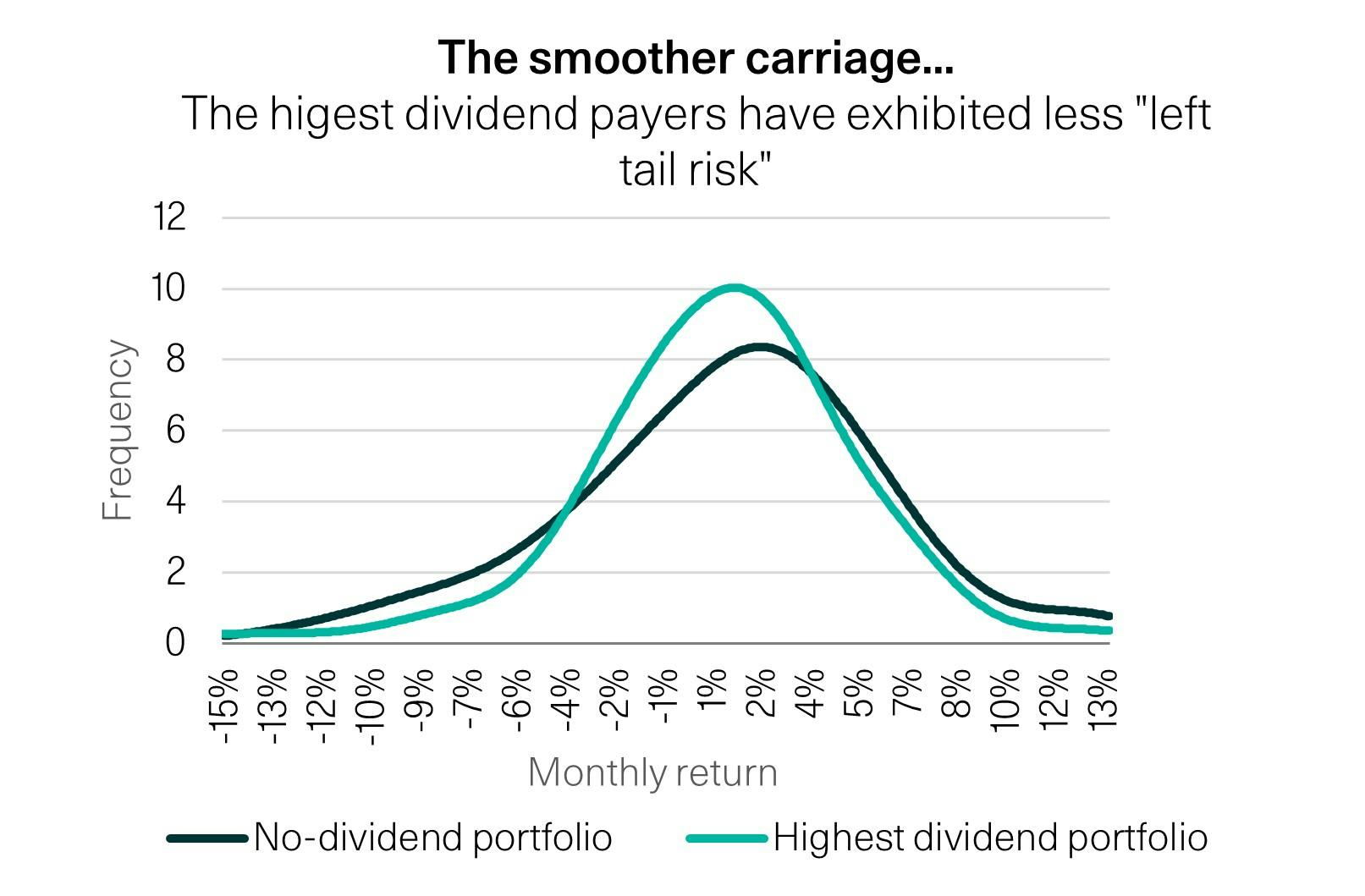
Despite a slightly bumpier ride (figure 2 draws out the distribution of monthly returns, which demonstrates dividend paying stocks exhibit slightly more left-tail risk or a greater predisposition to steep share-price declines) zero-dividend-paying stocks have also been a better way of funding spending.
Figure 3
Source: W1M, Kenneth R. French's data library
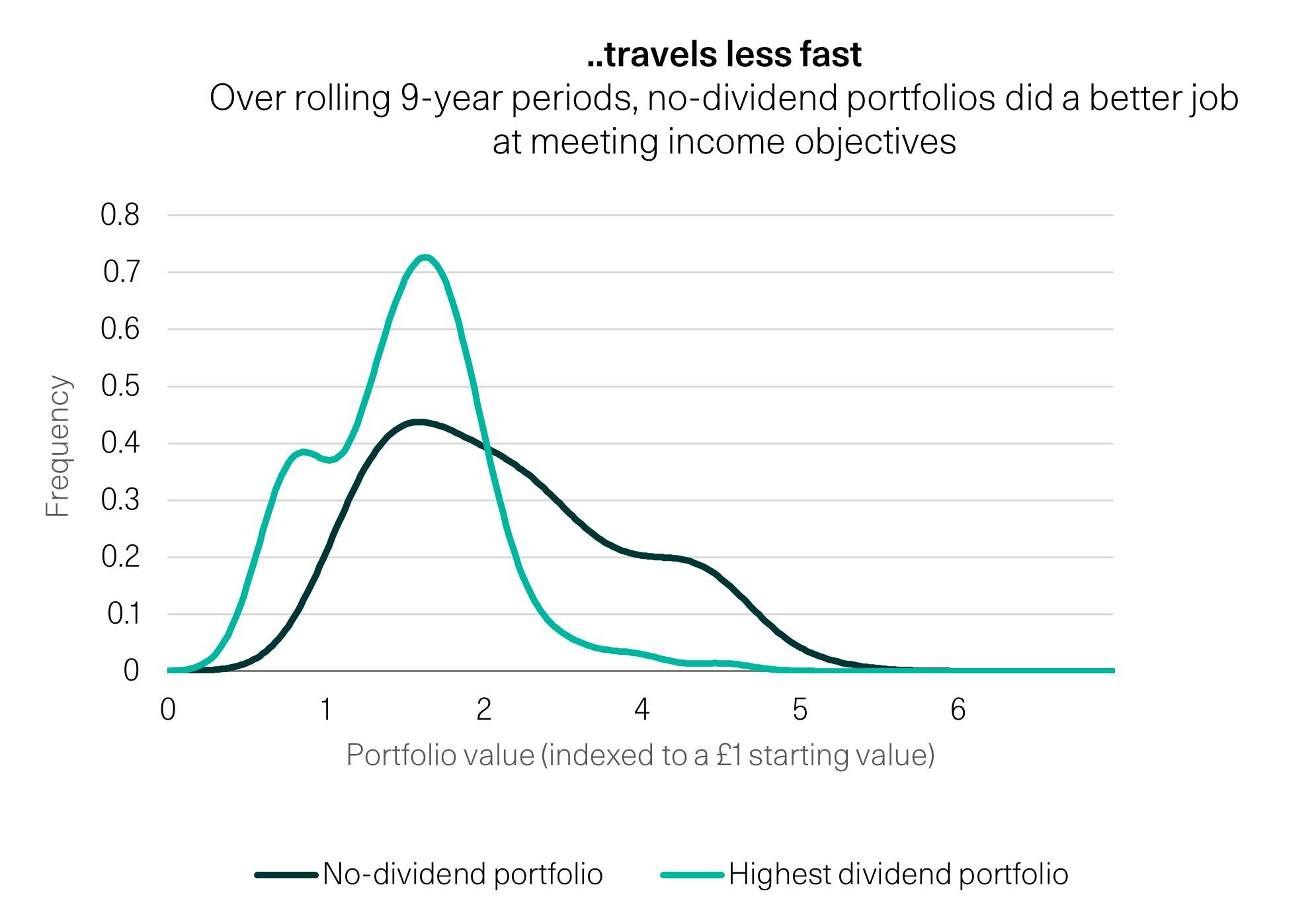
Examining the distribution of rolling nine-year (a healthy trustee tenure) portfolio value outcomes, and assuming a four-pence spend for every pound starting value, reverses the previous pattern. Higher-dividend-paying portfolios now exhibit more left-tail risk (a greater predisposition to lower, and negative, portfolio values). An attempt to smooth income provision producing the stability of a graveyard.
This is a deliberately extreme example (inclusion of the dotcom crash within the sample period would temper even the boldest investor’s enthusiasm for firms that entirely refuse cash returns to investors) but it remains that maximising return on capital (within risk tolerance) should be the focus of any investment policy; forcing the selection of higher-dividend investments can be a costly delusion of security.
Home bias hinders progress
“The city had at last joined the Customs Union, and small retail firms all over the country were growing, within a few years, into large wholesale ones – the firm, or Johann Buddenbrook rested on its oars and reaped no advantage from the favourable time.”
Then, as now, successful investment requires global context. The Buddenbrooks’ inherited position and influence within the free-market city of Lübeck and its network of Kontore (walled or bounded independent compounds such as London’s steelyard, now Cannon Street) but the economic moat afforded by the Hanseatic shelter thins as the novel progresses. Technological advances combine with shifting patterns of production to shift trade routes away from the Baltic coast, while in 1868 Lübeck joined the Prussian-led Zollverein customs union (swapping free-city customs privileges and legal autonomy for access to a larger market).
Mann’s record of a patrician, Lübeck-bound merchant house outpaced by a newer, more expansive global capitalism is not without parallel to the inadvertent domestic focus that an income tilt inflicts. Differences in contemporary dividend culture are significant, largely shaped by national tax and governance norms. As the US has led the shift from dividends to buybacks, income tilts can inadvertently overweight what’s local: the S&P 500 pays a paltry 1.3% in dividends but returns nearly 2% via buybacks, whereas the Euro Stoxx 600 offers about 3.3% in dividends and a similar 1.9% in buybacks. Sector mix explains some of this, but regardless, awarding our continental cousins more of a charity’s capital merely because they favour dividends (around 64% of total shareholder returns in Europe versus roughly 40% in the US) seems like poor policy design.
While captious corporate financiers will roll their eyes at the suggestion that dividends and share buybacks are equivalent, it strikes us that return on capital is a better lens through which to discriminate rather than the means by which capital is returned. Particularly, as the Americans are seemingly the doyennes of a growing global mode; astonishingly, buybacks have almost tripled in value since 2012 (+182%), outpacing the 54% increase in dividends over the same period, according to Janus Henderson Global Dividend Index Edition 38 (May 2023).
Fishing in a shrinking pool
“If she waits for somebody to come along who is an Adonis and a good match to boot – well, God bless us, Tony Buddenbrook could always find a husband, but it’s a risk, after all. Every day is fishing-day, but not every day is a catching-day.”
Aristocrats have always had a stubborn penchant for endogamy. In her choice of husband, Tony Buddenbrook let pedigree pass for proof, yielding to Bendix Grünlich, the rosy-faced, blue-eyed Hamburg speculator. His goose-like eyes, golden mutton-chop whiskers and obsequious polish should have paid caution to his financial fraudulence and eventual ruin – but the blinding burden of family sense and duty forces Tony’s acquiescence to class codes and the rejection of an authentic love: Morten Schwarzkopf, the candid, productive, middle-class medical student and personification of modern ideas.
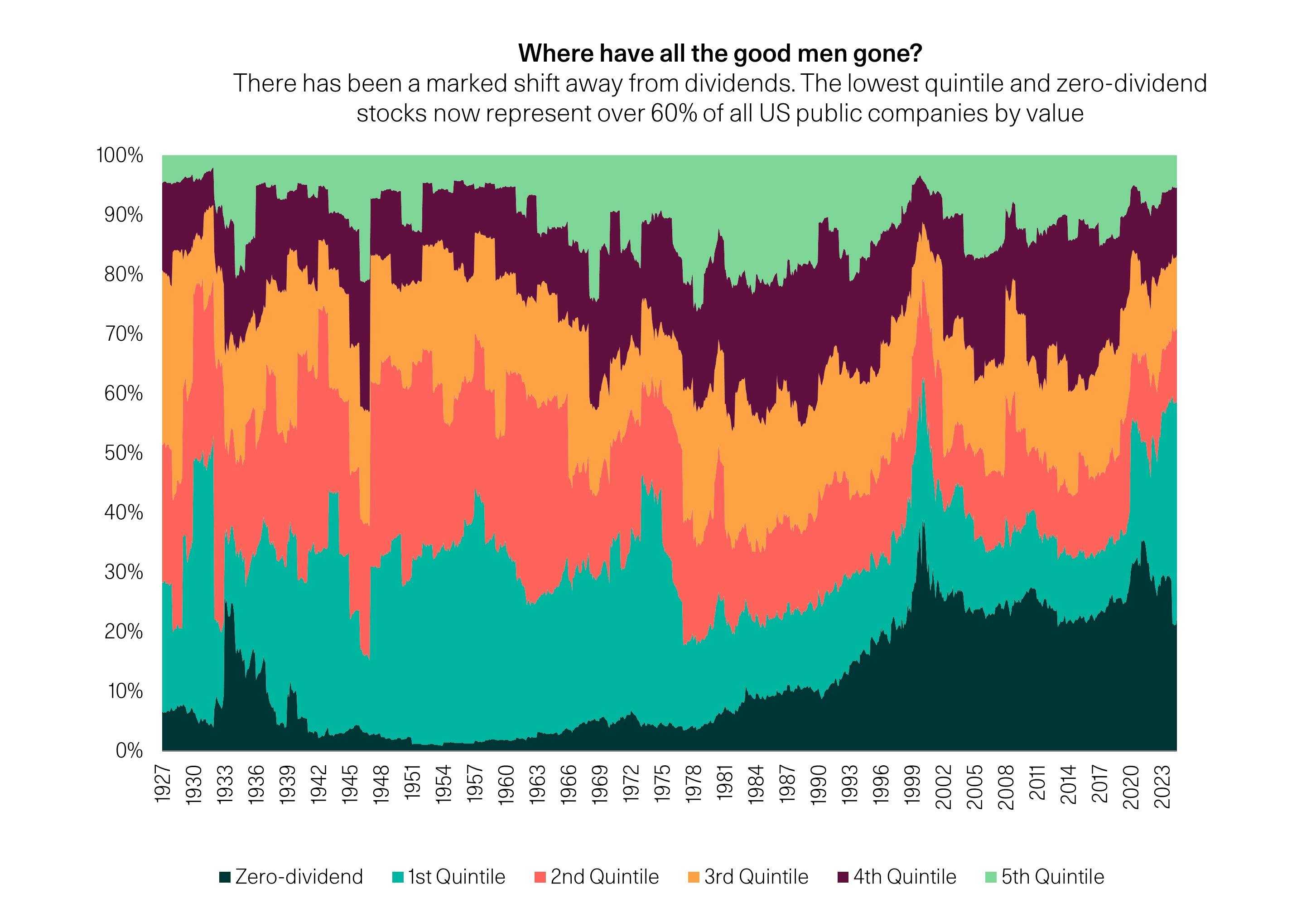
Sadly, income-obsessed charity trustees are the modern-day Fräuleins hopefully casting their hooks in unnecessarily small pools. Again, Kenneth French’s database is instructive. The next chart breaks out the change in weight (by market capitalisation) of each dividend ranked quintile (and includes the zero-dividend stocks too) for all public US companies.
Figure 4
Source: W1M, Kenneth R. French's data library
Figure 5
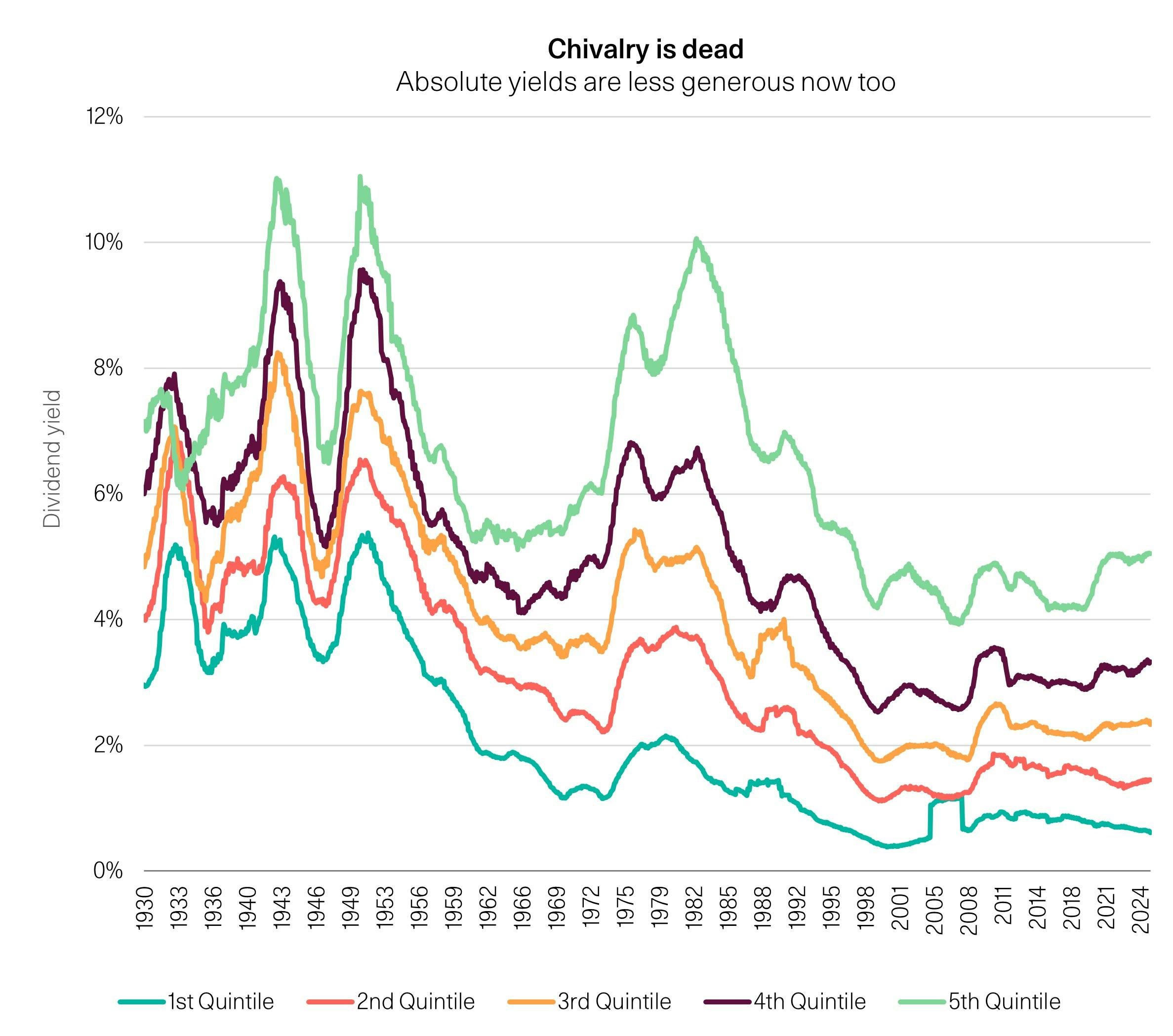
Source: W1M, Kenneth R. French's data library
The shift in market composition towards low and zero-dividend stocks is obvious and significant; the lowest quintile and zero-dividend stocks now represent over 60% of all US public companies by value. We also go one step further and examine the shift in category definitions (what yield earns you the esteem of being the highest payer). Notably, a representative 3% dividend stock would have sat in the 1st quintile (lowest paying) in the 1930s (well over 80% of the universe by market cap would pay dividends in excess). Today we’d be looking around the 4th; our universe of suitors is less than 20% of US public companies by market value. Where have all the good men gone?
Summary and conclusions
The Buddenbrooks remind us that prudence and resilience are two different things. Spending surety comes from a clear IPS and disciplined cash-flow design – not from a headline dividend yield. Pushing portfolios to yield more concentrates risk, and may well result in significant reductions in total return – the ultimate font of sustainable spending.
If you can’t shed your capital return focus entirely, route-agnosticism is the right lens. Total shareholder return recognises both that cash comes back via dividends and buybacks and that many markets now favour the latter. Ignore buybacks and you understate a portfolio’s true “cash-back” capacity and may risk herding into yesterday’s payers.
Guard equally against the quiet creep of home bias. A dividend target nudges allocations toward regions and industries with an income culture. The result is unintended concentration, policy and currency exposure, and a portfolio tied to local fashions rather than global opportunity.
What ultimately secures programmes of charitable spend is a policy that neutralises bad timing and preserves option value: a liquidity sleeve (one–two years’ spend in cash, short bonds and/or inflation-linkers – bonds have a yield now, why not make use of it!) paired with total-return investing and explicit spending rules. A yield target can feel sensible, but endurance comes from stewardship, not stipends.
Past performance is not a reliable indicator of future results. The value of investments and the income derived from them may rise as well as fall, and investors may not get back the amount originally invested. Capital security is not guaranteed.
This material is provided for informational purposes only and does not constitute investment advice or a recommendation. It should not be considered an offer to buy or sell any financial instrument or security. Any investment should be made based on a full understanding of the relevant documentation, including a private placement memorandum or offering documents where applicable. W1M Wealth Management Limited is authorised and regulated by both by the Financial Conduct Authority of 12 Endeavour Square, London E20 1JN, with firm reference number 120776 and the U.S. Securities and Exchange Commission of 100 F Street, NE Washington, DC 20549, with firm reference number 801-63787. Registered in England and Wales, Company Number 02080604.
All rights reserved. No part of this publication may be reproduced, distributed, or transmitted in any form or by any means, including photocopying, recording, or other electronic or mechanical methods, without prior written permission from W1M Wealth Management Limited.
Copyright © 2026 W1M Wealth Management Limited.