2025 - A year of tax shifts and quiet recalibration

The November Budget proved to be a significant disappointment across the industry. Expectations had been high for meaningful reform, but in practice it delivered little in the way of substantive change. Against this backdrop, Tahir Mahmood and Grant Hudson discuss the developments in 2025 most likely to affect our clients.
This is not a technical briefing, nor a comprehensive summary of rates and thresholds. Rather, it is an invitation to look beyond the headlines and reflect on what 2025 revealed about the growing intersection between tax, everyday financial planning, long-term strategy, and the wider economic environment.
Frozen thresholds: A stealth shift - Perhaps the most pervasive theme of 2025 was the continued freeze on key personal tax thresholds.
- The Income Tax personal allowance and rate thresholds were legislated to remain at current levels well into the next decade, now locked in until at least 2031.
- With wages and inflation moving upward over the same period, this effectively means more people will be drawn into higher tax bands over time, even without rate changes, a form of stealth tax rise through bracket creep.
Dividend and savings income: Targeted increases - 2025 set the stage for higher taxes on investment income:
- Dividend tax rates were confirmed to rise by two percentage points from April 2026.
- From 2027, similar increases will apply to savings and property income, lifting basic and higher rate bands on these income types.
For investors and those reliant on passive income streams, these adjustments signal that investment income will face progressively higher tax costs in the years ahead.
How does this impact me:
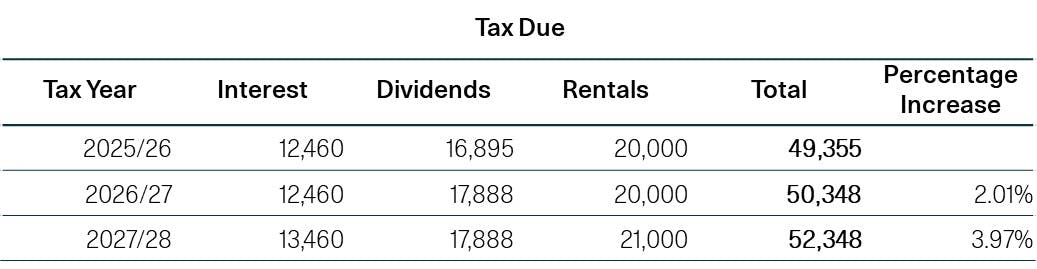
The table below illustrates the projected increase in income tax over the next three tax years for an individual with £150,000 of income split equally between interest, dividends and rental:
New property (high-value) tax - “mansion tax”
- Under the new proposals, from April 2028, properties with a market value over £2 million will face an additional annual levy.
- The surcharge will apply on top of existing council tax liabilities.
- The levy will be tiered: properties valued between £2 million and up to £5 million, will incur a flat annual fee of £2,500, increasing to £7,500 annually for individuals with homes more than £5 million.
Homeowners well above the £2 million threshold, especially in London and other high-value regions, will need to factor this new recurring cost into their long-term financial planning.
Pension “salary-sacrifice” contributions now taxed for NI
Another major policy affects those using salary-sacrifice schemes to contribute to pensions. The Budget proposes to charge National Insurance contributions (NICs) on pension contributions made via salary sacrifice.
- From 2029, pension contributions over £2,000 per year made via salary sacrifice will no longer be exempt from NICs.
- For employees, particularly higher earners or those contributing significantly to their pension via salary sacrifice, this change could erode some of the long-standing tax advantages of salary-sacrifice pension schemes. Couples and individuals who rely heavily on those arrangements may want to review their pension strategies.
Renter’s Rights Act
The Renters’ Rights Act represents the most significant overhaul of the private rented sector in England for a generation. Introduced to improve security, fairness and standards for tenants, the reforms also bring substantial changes to landlords’ legal obligations and how tenancies are managed. With implementation beginning from 2026, landlords need to understand how these new rules will affect possession rights, rent setting, tenancy structures and compliance requirements across their portfolios.
Making tax digital
During 2025, the UK government used the year primarily to finalise and reaffirm the rollout of Making Tax Digital (MTD) for Income Tax Self-Assessment, rather than introducing immediate changes for individuals. Official announcements and Spring Statement publications confirmed that 2025/26 remains a transitional year, with no mandatory MTD requirements applying to personal taxpayers yet. However, HMRC clarified the framework that will govern future compliance, including the structure of digital record-keeping, quarterly updates, and a new digital end-of-year declaration to replace elements of the current Self-Assessment process.
The most significant development in 2025 was the confirmation of a staged mandation timetable for MTD for Income Tax. From April 2026, sole traders and landlords with gross qualifying income over £50,000 will be required to keep digital records and submit quarterly updates using compatible software, with the threshold reducing to £30,000 from April 2027 and £20,000 from April 2028. For personal taxpayers, particularly landlords, 2025 therefore marked a clear shift from policy uncertainty to implementation planning, signalling that digital reporting will soon become the standard method of managing personal tax affairs in the UK.
Farmer rules changed last minute
In a late-2025 update, the UK government increased the inheritance tax relief threshold for farmers and rural business owners. The move ensures that family farms and qualifying business assets can be passed on with much less tax liability than earlier proposals would have allowed, offering a significant reprieve for estates at risk of forced asset sales.
- 100% APR/BPR relief now applies to £2.5 million per estate, rising to £5 million for couples.
The change takes effect from 6 April 2026, providing certainty for family farms and rural businesses
What 2025 tells us
Stepping back, several underlying themes emerged:
- Incremental pressure: Many changes were subtle, threshold freezes, incremental rate rises on specific income types, but together they add meaningful tax burden over time.
- Policy direction matters as much as headline rates: Freezes and structural realignments will often have more impact than occasional small rate tweaks.
- Planning horizons need to extend: With many measures phased in across multiple years (e.g. dividend tax from 2026, savings income from 2027), proactive planning now will pay dividends later.
Most importantly, 2025 underlined that UK tax policy is no longer a backdrop to planning: it is a dynamic force shaping wealth, work, and investment decisions across the economy.
This material is provided for informational purposes only and does not constitute tax, legal or financial advice and should not be relied upon as such. W1M and our affiliates do not provide legal or tax advice. Investors should consult their financial and tax advisors to assess the tax implications of any investment. Tax treatment depends on the individual circumstances of each client and may be subject to change in the future.
The views expressed reflect current market conditions and are subject to change without notice. Any references to taxation are based on current understanding and may change.
This material is provided for informational purposes only and does not constitute investment advice or a recommendation. It should not be considered an offer to buy or sell any financial instrument or security.
Any investment should be made based on a full understanding of the relevant documentation, including a private placement memorandum or offering documents where applicable.
W1M Wealth Management and its affiliates do not provide legal or tax advice. Any references to taxation are based on current understanding and may change. Investors should seek independent tax advice tailored to their individual circumstances.